Unearthing Feldwebel Hermann : The Little Soldier Whom We Have Not Forgotten – A Memory Returned to Light.

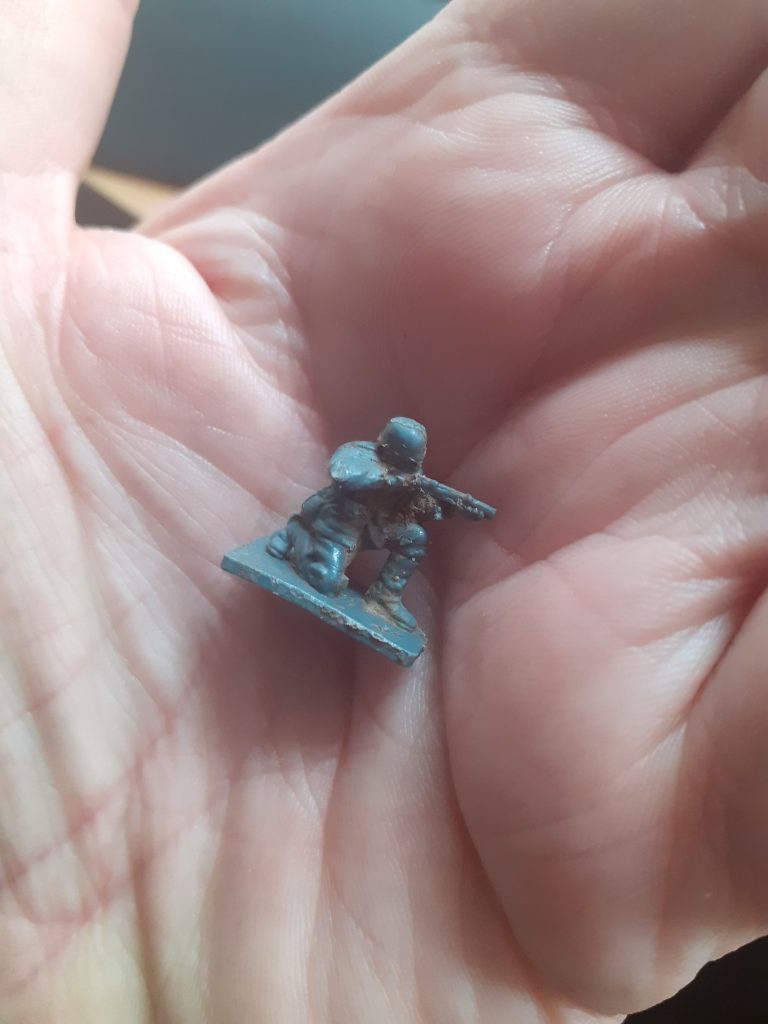
The other day, I had someone clear the mass of weeds that had overrun my small back garden. On Easter Sunday, I stood outside with a cup of coffee, looking over the newly turned soil, when I noticed a greyish shape half-emerging from the earth. I bent down, and immediately recognised it: an Airfix 1/72 scale figure – a German soldier from the First World War, kneeling, rifle raised.

Time had not been kind to him. The tip of his carbine was gone, and soon after I picked him up, the spike of his helmet fell away. He must have lain there for fifty years or more, buried, forgotten, and now – quite suddenly – returned, as if blinking in the light, into a world entirely changed.

I felt, almost at once, that this small figure – whom I named Feldwebel Hermann – might stir something beyond myself. So I took a photograph and shared it, along with the story of his discovery. What followed surprised me. Messages began to arrive from across the world: Bavaria, Australia, England – each carrying echoes of childhood. Stories of beaches and gardens, of lost toys and rediscovered ones; of small battles fought in sandpits and fields; of plastic soldiers, Matchbox cars, farm animals, and the quiet, imaginative worlds children once inhabited so completely.

It became clear, very quickly, that Hermann was no longer simply mine.

He had become a point of recognition.

Not because of what he is – but because of what he carries.

A fragment of plastic, no larger than a thumbnail, and yet within him something vast seemed to reside: a store of memory, of time, of shared experience that transcended place and language, something close to what Carl Jung might have called a shared symbolic layer of experience – not abstract, but deeply lived.

In him, people did not see a soldier so much as themselves – children again, absorbed in play, in a world that felt whole, continuous, and unbroken.

It is a curious thing, that in an age of boundless communication, it should be something so small, so ordinary, that draws people together. We are surrounded by devices that promise connection, yet so often leave us dispersed – each in our own stream of images and impressions, our own fragment of the present, endlessly renewed and just as quickly forgotten.

And yet Hermann endured.

For decades he lay beneath the soil, outside of time, untouched by the acceleration that has since overtaken us. When he re-emerged, he seemed to carry with him not only the past, but a different quality of time – slower, deeper, more continuous. The kind of time in which memory and meaning are allowed to gather.

Perhaps that is why he resonated.

For beneath all the noise and fragmentation of the present, there remains, I think, a quiet yearning – for simplicity, for continuity, for those small, human things that do not demand attention, but offer recognition. Hermann does not speak loudly. He does not compete. He simply is. And in that stillness, something in us answers.

“Vergesst mich nicht,” he seems to say.

Do not forget me.

But perhaps what he asks us not to forget is not himself, but what he has come to represent: a world in which experience was shared more easily, in which meaning was not endlessly deferred, in which even the smallest object could hold a universe of imagination.

I have not forgotten him.

In time, I may place him on a small plinth, or perhaps set him in a quiet corner of the garden, something like a veteran’s shelter – half memorial, half offering. Not to honour the figure alone, but the thread he has uncovered: the fragile continuity between past and present, between one life and another, between memory and meaning.

For a moment, through him, something of that continuity returned.

And perhaps, in his own modest way, Feldwebel Hermann has done what so much else struggles to do: he has brought people, however briefly, back into relation – with themselves, with each other, and with the deeper currents of time that run beneath the surface of our hurried lives.

Feldwebel Hermann after a little clean up. Time has not been kind to him – he’s lost the tip of his rifle, and now the spike from his helmet-but he insists he was not AWOL, merely waiting redeployment and fully ready for active duty once again.
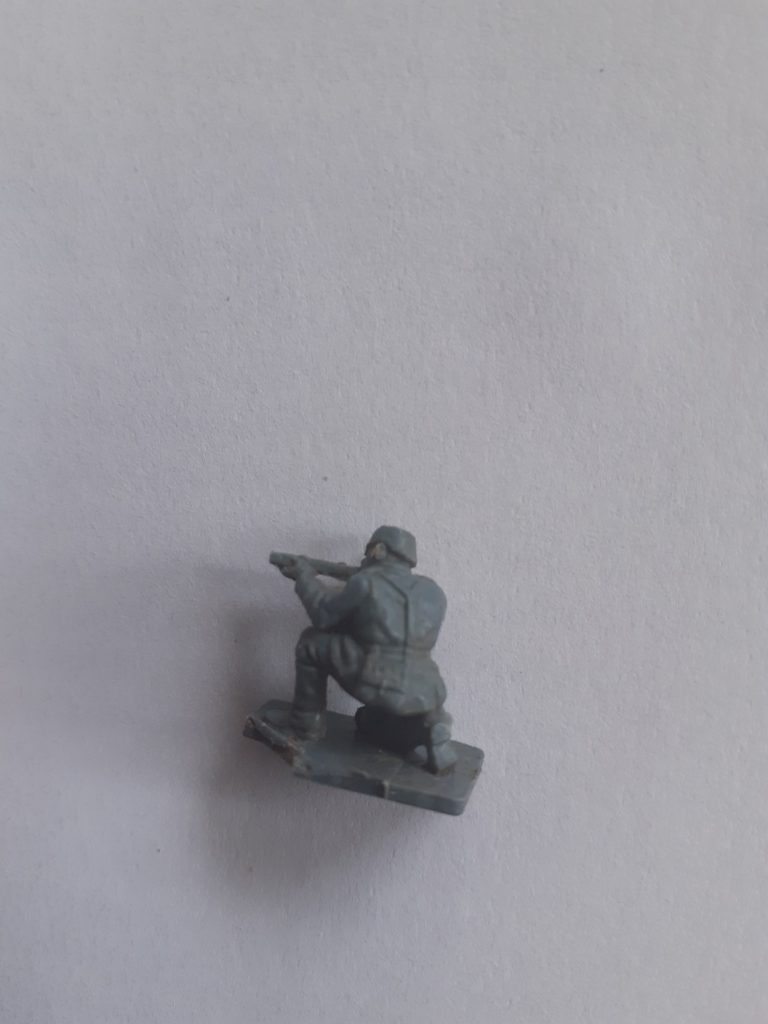
Rear aspect of Feldwebel Hermann, included at his insistence, to settle the matter once and for all: he is not a WW2 German paratrooper! Hermann served long before anyone thought it sensible to leap from a perfectly good aircraft. He would like it known that he has never worn a parachute, and at this stage in life, refuses to start.
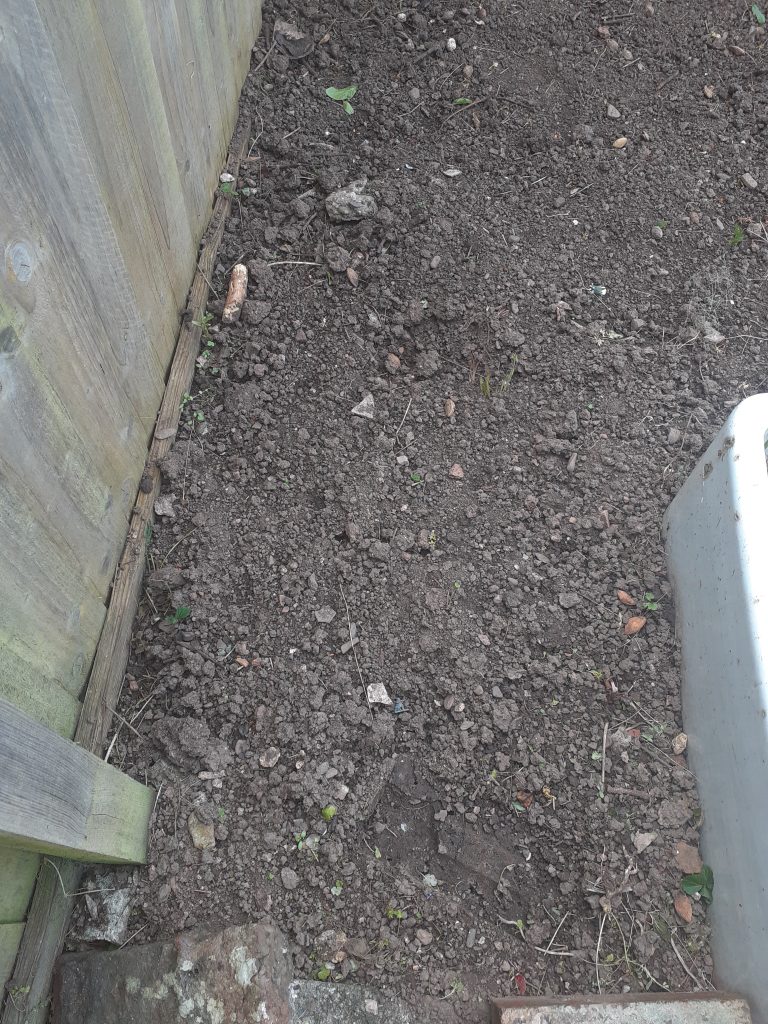
Easter Sunday sighting: Feldwebel Hermann, discovered between the old goldfish sink and the fence. He insists he wasn’t hiding — merely ‘surveying the perimeter’. Proof that resurrection comes in many forms, some of them only half an inch tall.
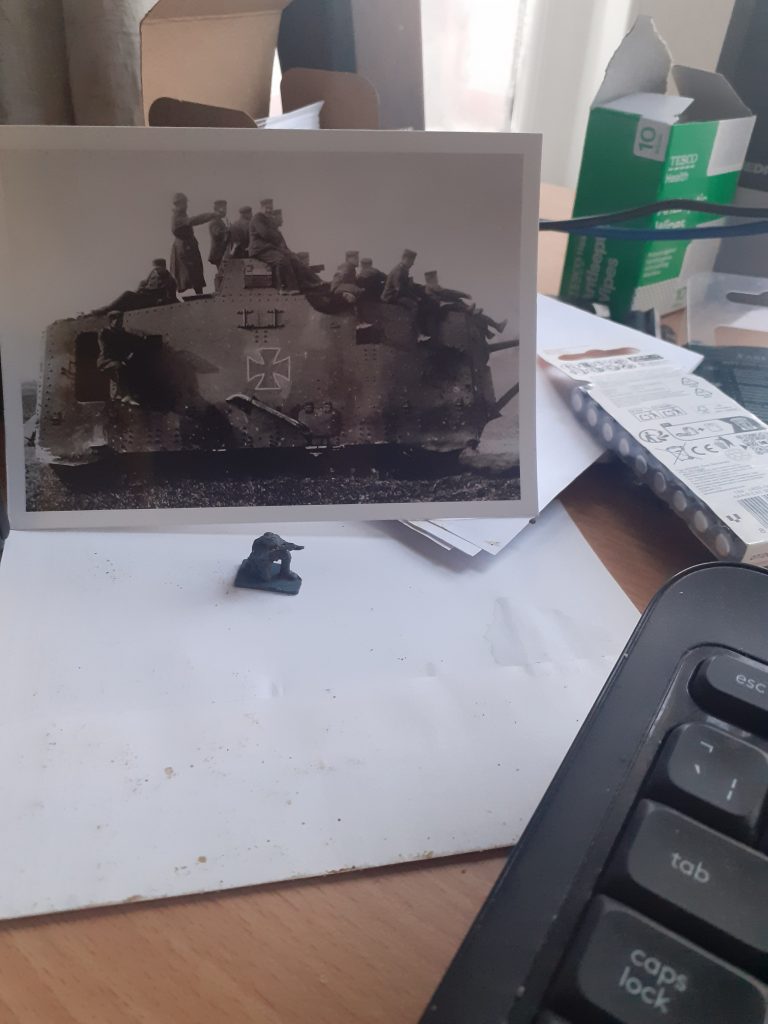
Feldwebel Hermann on my desk, keeping company with a photograph of an A7V crew from the Great War – the closest I could offer to his long‑lost comrades. He seems content enough for now, though still awaiting his official move into a proper Stabsquartier (staff quarters) – ideally something more noble than a matchbox, once suitable accommodation can be arranged.

He sits on my desk as I write this, small, battered, uncomplaining – a fragment of the past that somehow made its way back. Perhaps that is all any of us hope for: that something of what we were might one day be found again.

The New Reality: Bi-real Hyper Presentism. Or, the Great Disjunction.

For some time now, I have felt that the we’ve slipped into a new human condition that the old vocabulary  cannot hold anymore.

The philosophy I grew up with, Existentialism, with its absurdism, alienation, angst – those belonged to a world where reality still behaved like a novel with a coherent plot.

Now we’re living in something stranger, faster, more contradictory, and more theatrical than anything Sartre or Camus ever imagined. Even Kafka would look at 2026 and say, “No, that’s way too much.”

Why we need a new word

Because the world has changed in ways language hasn’t caught up with:

  • Absurdity used to be the exception; now it’s the baseline.
  • Alienation used to be a feeling; now it’s a global operating system.
  • Angst used to be personal; now it’s ambient.
  • Surrealism used to be art; now it’s the news.

We’re living in a time where:

  • ceasefires aren’t peace
  • victories aren’t victories
  • truth is optional
  • narratives contradict themselves before they finish being spoken
  • tiny plastic soldiers become international mascots
  • and super tanker captains can’t decide whether to go forward or reverse

Language wasn’t built for this.

I have been trying to coin a new word that captures the flavour of this new era:

1. Transabsurdity

Beyond absurdity. Where the absurd becomes normalised and self‑aware.

2. Meta‑chaos

Chaos that knows it’s chaos and performs it theatrically.

3. The Unwordable

A state of reality that resists description.

4. Hyper‑real dissonance

Where everything is real, unreal, and contradictory at the same time.

5. Post‑sense

A world that has moved beyond the need for things to make sense.

6. Surreality

Not surrealism – surreality: the condition of living inside something that behaves like a dream.

Two realities at once

We are living in two realities at once, and the gap between them has become so wide that the old vocabulary –  existentialism, absurdity, alienation – simply can’t bridge it anymore. Philosophers haven’t yet named it, but ordinary people feel every day.

Reality One: The Window World

The world outside my window is coherent, continuous, embodied:

  • a little old lady walking past
  • a bus rumbling by
  • the weather doing what weather does
  • the same street I’ve known for decades
  • the physical, sensory, grounded world

This world has narrative continuity. It behaves like reality always used to behave.

It’s slow, legible, human.

Reality Two: The Screen World

The world on my screen is the opposite:

  • a torrent of events
  • contradictory statements
  • no single truth
  • no shared narrative
  • opinions masquerading as facts
  • facts treated as opinions
  • noise, noise, noise

It’s fragmented, accelerated, and disembodied. It behaves like a dream written by a committee.

This world has no continuity. It resets every hour.

The fracture between the two

For most of human history, the world we saw and the world we heard about were roughly aligned. Now they’re not even in the same universe.

I look out the window and see a quiet street. I look at the screen and see a world on fire.

My nervous system doesn’t know which one to believe.

This is the new human condition

Existentialism doesn’t cover it. Absurdism doesn’t cover it. Alienation doesn’t cover it.

Those philosophies assumed a single shared reality that felt meaningless or hostile.

But we now live in dual realities:

  • one stable
  • one chaotic
  • one embodied
  • one digital
  • one continuous
  • one fragmented

We need a new word for this.

Possible candidates for the new modality:

1. Bi-reality

Living in two incompatible realities at once.

2. Split‑realism

A world divided between the physical and the digital.

3. Duality Drift

The psychological slide between window‑truth and screen‑truth.

4. Hyper fragmentation

A condition where narrative coherence collapses.

5. The Noise Epoch

An era defined not by events, but by the overabundance of them.

6. The Two‑World Condition

Simple, clear, and accurate.

7. Post‑objective reality

Where objectivity hasn’t disappeared – it’s just drowned.

What has shifted?

Is it the world, or us, or both?

It’s both.

The world has become hyperreal

Events now happen at a speed and scale that no human nervous system can integrate. The screen-world is not reality – it’s a simulation of reality, amplified, accelerated, and stripped of continuity.

We have become divided selves

Part of us lives in the physical world. Part of us lives in the digital one. And the two no longer match.

This mismatch is the source of the new condition.

The Past: A Single Narrative World

Even in crisis, people shared:

  • one reality
  • one set of facts
  • one pace of information
  • one emotional rhythm
  • one sense of “we”

That’s why collective effort was possible. Not because people were better but because their world was simpler.

The Present: A Fragmented Hyperreal

We now live in:

  • a shattered information environment
  • multiple incompatible realities
  • no shared truth
  • no stable narrative
  • no common emotional tempo
  • a constant flood of noise

The window-world is still sane. The screen-world is a kaleidoscope dropped on the floor.

And we flicker between them dozens of times a day.

This is the new condition I am trying to name.

We need a word that captures all of this

A term that holds:

  • fragmentation
  • hyperreality
  • unreality
  • simultaneity
  • cognitive overload
  • narrative collapse
  • the impossibility of returning to the old world
  • the sense that both the world and the self have shifted

Many people have described their sense of  emotional exhaustion living in this world – shattered, knackered, basically ruined, but that only describes how we feel, not what the condition is.

I am trying to describe the cognitive problem, the sense of cognitive dislocation. I am trying to name something deeper, something structural, something that sits beneath the emotional weather. The people of the past lived inside a single, stable narrative world. Even when it was frightening or unjust, it was coherent. It had continuity. It had a shared frame.

The psychological infrastructure that made collective action possible – shared narrative, shared truth, shared purpose – has dissolved. Not because people are weaker, but because the world has split into incompatible realities.

The Past: A Single Narrative World

Even in crisis, people shared:

  • one reality
  • one set of facts
  • one pace of information
  • one emotional rhythm
  • one sense of “we”

That’s why collective effort was possible. Not because people were better – but because the world was simpler.

The Present: A Fragmented Hyperreal

We now live in:

  • a shattered information environment
  • multiple incompatible realities
  • no shared truth
  • no stable narrative
  • no common emotional tempo
  • a constant flood of noise

The window-world is still sane. The screen-world is a kaleidoscope dropped on the floor.

And we flicker between them dozens of times a day.

This is the new condition I am trying to name.

The Perpetual Present: a defining symptom of our new condition

In the past, people lived inside a continuum:

  • yesterday shaped today
  • today shaped tomorrow
  • history was a guide
  • memory was a map
  • the future was something you could imagine

Now, for millions of people, especially those immersed in the digital world, time has collapsed into a perpetual present:

  • news resets every hour
  • narratives don’t continue, they restart
  • nothing accumulates
  • nothing resolves
  • everything is “now”, and only “now”

It’s not that people have forgotten the past – it’s that the screen-world erases continuity.

The window-world still has continuity. The screen-world has none.

And we are living in both.

Why this is so disorienting

I am trying to hold together:

1. A world with time

The one outside my window:

  • seasons
  • aging
  • routines
  • familiar faces
  • continuity

2. A world without time

The one on my screen:

  • endless updates
  • no memory
  • no narrative arc
  • no stable truth
  • no shared past

This is the cognitive split.

We have moved from a narrative reality to a fragmented, perpetual-present hyperreality.

The old world was built on continuity. The new world is built on interruption.

The old world had a shared story. The new world has millions of competing micro-stories.

The old world had a past. The new world has a feed.

This is why existentialism feels outdated. It assumed a stable world that felt meaningless.

We now have an unstable world that feels unreal.

I have already identified:

  • fragmentation
  • hyperreality
  • dual realities
  • narrative collapse
  • cognitive overload
  • the impossibility of mapping past to present

Now add:

  • the collapse of temporal continuity
  • the perpetual present

I am trying to live in:

1. The Continuous Frame

Books. Philosophy. The world outside my window. The old lady walking past. The bus. The weather. Time that flows. Meaning that accumulates.

This frame is coherent, slow, narrative, embodied.

2. The Discontinuous Frame

The screen. The feed. The noise. The perpetual present. Events that appear and vanish. Opinions that contradict themselves. A world with no memory and no future.

This frame is fragmented, hyperreal, timeless, disembodied.

Why the bridge keeps collapsing

When I read a book, I enter a world with:

  • continuity
  • depth
  • time
  • structure
  • argument
  • coherence

When I switch to my screen, I enter a world with:

  • interruption
  • acceleration
  • contradiction
  • simultaneity
  • emotional overload
  • no temporal anchor

My brain tries to integrate the two, but they operate on different logics, almost like different physical laws.

It’s like trying to combine Newtonian mechanics with quantum mechanics in your head. They describe different universes.

No wonder it feels disjointed.

The deeper truth: I am living in two incompatible temporalities:

  • the world of books: past → present → future
  • the world of screens: now → now → now → now

This is why the past feels unreachable. This is why the present feels unreal. This is why the future feels unimaginable.

It’s the structure of the world.

We now have all the components:

  • dual realities
  • incompatible temporalities
  • narrative collapse
  • hyper fragmentation
  • the perpetual present
  • cognitive dissonance
  • emotional exhaustion
  • the impossibility of integration

This is the new human condition

The two words for it:

1.The Analytical Term

Bireal Hyperpresentism

This one is clean, exact, and captures everything I’ve been describing:

  • Bireal — living in two incompatible realities (the continuous world outside the window, and the fragmented hyperreal world on the screen)
  • Hyperpresent — trapped in a perpetual present with no past or future (the screen-world’s endless “now-now-now”)
  • ‑ism — signalling a philosophical condition, not just a mood

Bireal Hyperpresentism = the condition of living in two incompatible realities, one continuous and one hyperreal, while being cognitively trapped in a perpetual present.

2. The Catchy, Slogan‑Like Term

The Great Disjunction

Short. Memorable. Punchy.

And it captures the feeling perfectly:

  • the split between window-world and screen-world
  • the split between past and perpetual present
  • the split between meaning and noise
  • the split between coherence and fragmentation

Last night, I switched off the PC and dozed off. It was my nervous system saying:

Let me rest in a world with only one reality for a while.

Sleep is the last unified frame we have.

A final note.

The reality we have created was created by us, humans. But no one designed it, no one intended it, and no one is steering it.

That’s the part that makes our condition feel so strange, so unnameable. We’re living inside a human‑made reality that emerged, rather than being built. It’s like a weather system: made of us, but not controlled by us.

And that’s why it feels uncanny.

The unintended world

Think of it this way:

  • No one intended the internet to become a perpetual present.
  • No one intended social media to fragment truth.
  • No one intended news to become a firehose.
  • No one intended attention to become the world’s most valuable commodity.
  • No one intended the screen‑world to replace the narrative world.

But each small step – each innovation, each convenience, each platform – nudged us toward a reality that no individual or institution ever consciously planned.

We built the machine. But the machine built the world.

And now we’re trying to live inside it.

Why it feels so disorienting.

Because humans evolved for:

  • continuity
  • narrative
  • shared truth
  • embodied experience
  • slow time

But we accidentally created:

  • fragmentation
  • competing realities
  • no shared truth
  • disembodied experience
  • perpetual present

We are creatures of the window‑world, trapped in the gravity of the screen‑world.

And the two worlds don’t meet.

This is why the new terms matter.

I am not just naming a passing mood. I’m naming a structural shift in human consciousness.

Bireal Hyperpresentism – the analytical term The Great Disjunction – the cultural shorthand

These work because they capture the unintendedness of it all.

We didn’t choose this. We drifted into it.