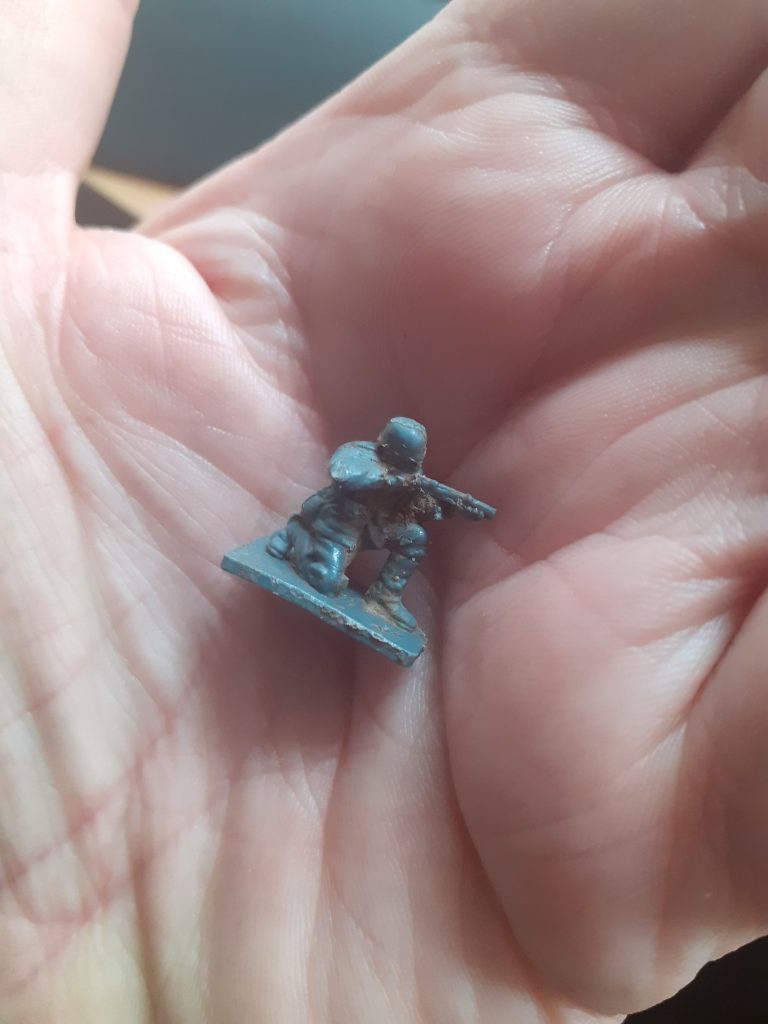
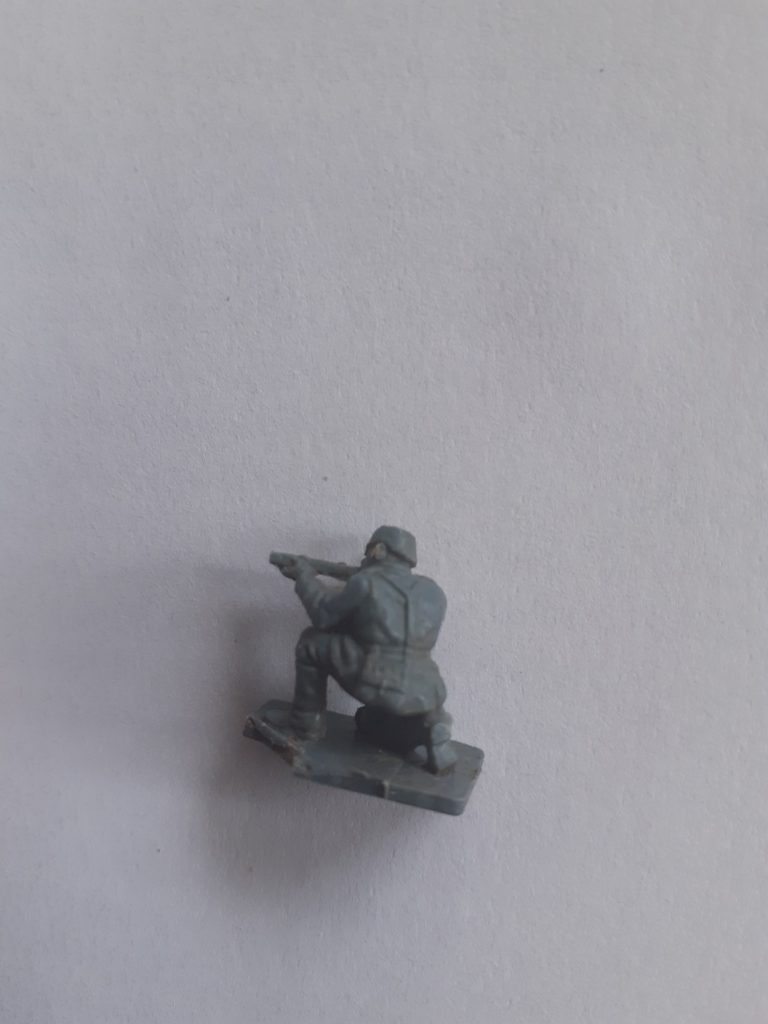
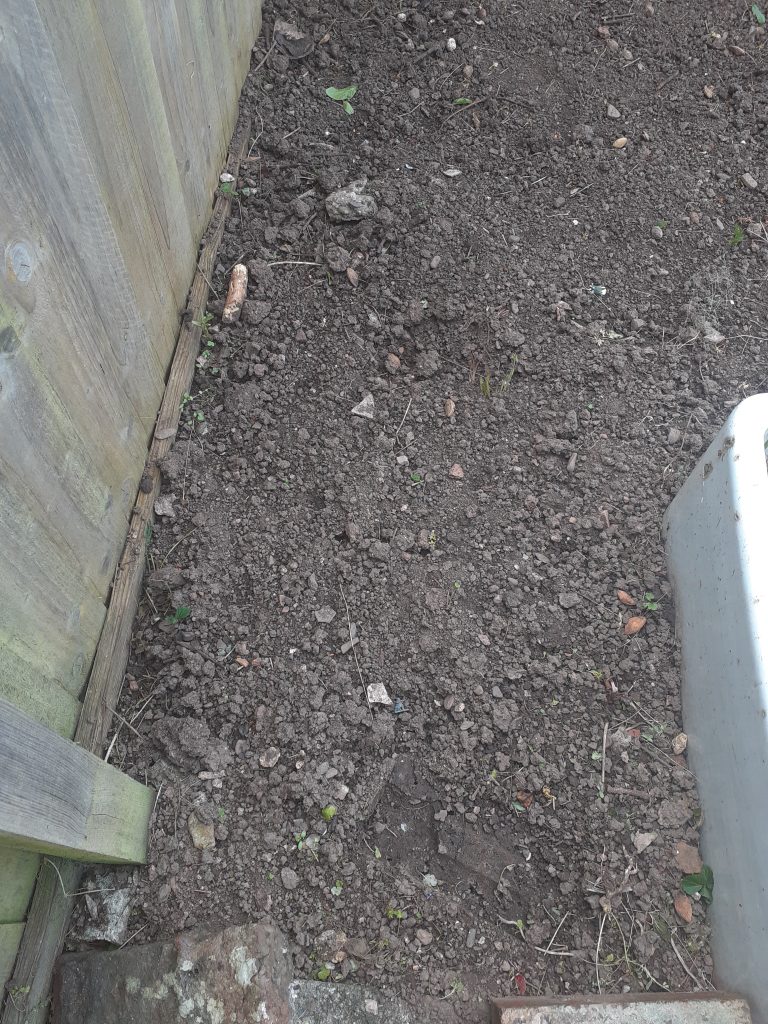
The other day, I had someone clear the mass of weeds that had overrun my small back garden. On Easter Sunday, I stood outside with a cup of coffee, looking over the newly turned soil, when I noticed a greyish shape half-emerging from the earth. I bent down, and immediately recognised it: an Airfix 1/72 scale figure – a German soldier from the First World War, kneeling, rifle raised.
Time had not been kind to him. The tip of his Mauser Gewehr 98 carbine was gone, and soon after I picked him up, the spike of his helmet fell away. He must have lain there for fifty years or more, buried, forgotten, and now – quite suddenly – returned, as if blinking in the light, into a world entirely changed.
I felt, almost at once, that this small figure – whom I named Feldwebel Hermann – might stir something beyond myself. So I took a photograph and shared it, along with the story of his discovery. What followed surprised me. Messages began to arrive from across the world: Bavaria, Australia, England – each carrying echoes of childhood. Stories of beaches and gardens, of lost toys and rediscovered ones; of small battles fought in sandpits and fields; of plastic soldiers, Matchbox cars, farm animals, and the quiet, imaginative worlds children once inhabited so completely.
It became clear, very quickly, that Hermann was no longer simply mine.
He had become a point of recognition.
Not because of what he is – but because of what he carries.
A fragment of plastic, no larger than a thumbnail, and yet within him something vast seemed to reside: a store of memory, of time, of shared experience that transcended place and language, something close to what Carl Jung might have called a shared symbolic layer of experience – not abstract, but deeply lived.
In him, people did not see a soldier so much as themselves – children again, absorbed in play, in a world that felt whole, continuous, and unbroken.
It is a curious thing, that in an age of boundless communication, it should be something so small, so ordinary, that draws people together. We are surrounded by devices that promise connection, yet so often leave us dispersed – each in our own stream of images and impressions, our own fragment of the present, endlessly renewed and just as quickly forgotten.
And yet Hermann endured.
For decades he lay beneath the soil, outside of time, untouched by the acceleration that has since overtaken us. When he re-emerged, he seemed to carry with him not only the past, but a different quality of time – slower, deeper, more continuous. The kind of time in which memory and meaning are allowed to gather.
Perhaps that is why he resonated.
For beneath all the noise and fragmentation of the present, there remains, I think, a quiet yearning – for simplicity, for continuity, for those small, human things that do not demand attention, but offer recognition. Hermann does not speak loudly. He does not compete. He simply is. And in that stillness, something in us answers.
It brings to mind an old Chinese adage: “The right man sitting in his house and thinking the right thought will be heard a hundred miles distant.”
Perhaps that is what happened here. Not through noise or intention, but through the quiet truth of the moment – a small figure, a simple thought, travelling farther than one might ever expect.
“Vergesst mich nicht,” he seems to say.
Do not forget me.
But perhaps what he asks us not to forget is not himself, but what he has come to represent: a world in which experience was shared more easily, in which meaning was not endlessly deferred, in which even the smallest object could hold a universe of imagination.
I have not forgotten him.
In time, I may place him on a small plinth, or perhaps set him in a quiet corner of the garden, something like a veteran’s shelter – half memorial, half offering. Not to honour the figure alone, but the thread he has uncovered: the fragile continuity between past and present, between one life and another, between memory and meaning.
For a moment, through him, something of that continuity returned.
And perhaps, in his own modest way, Feldwebel Hermann has done what so much else struggles to do: he has brought people, however briefly, back into relation – with themselves, with each other, and with the deeper currents of time that run beneath the surface of our hurried lives.
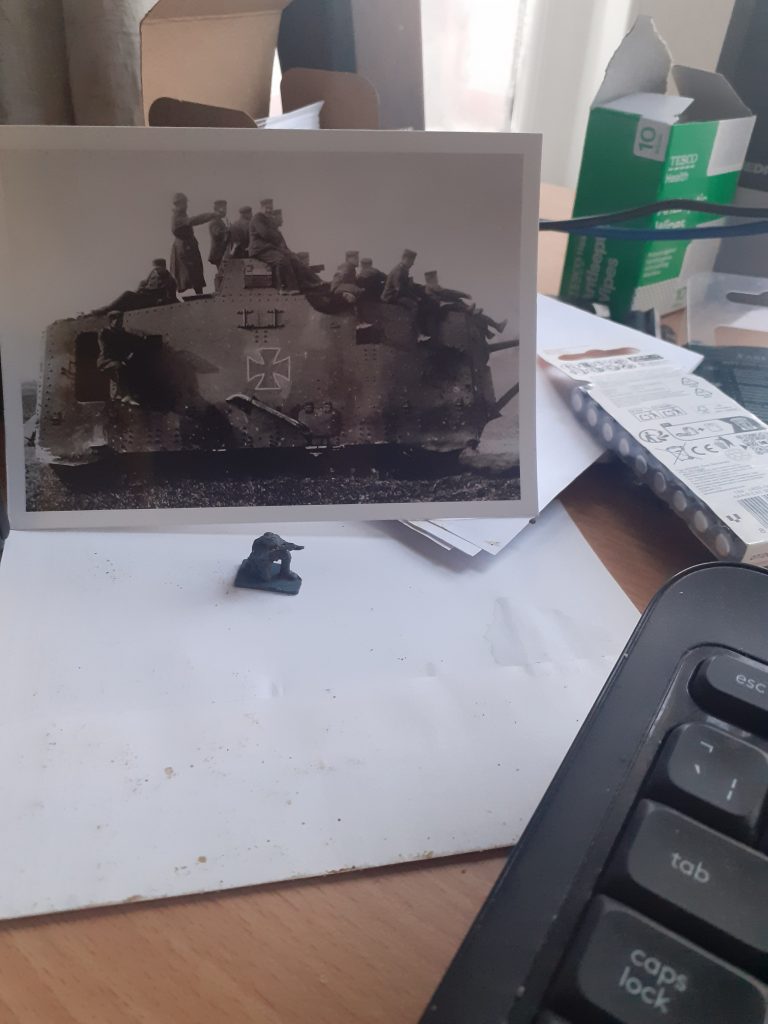
He sits on my desk as I write this, small, battered, uncomplaining – a fragment of the past that somehow made its way back. Perhaps that is all any of us hope for: that something of what we were might one day be found again.