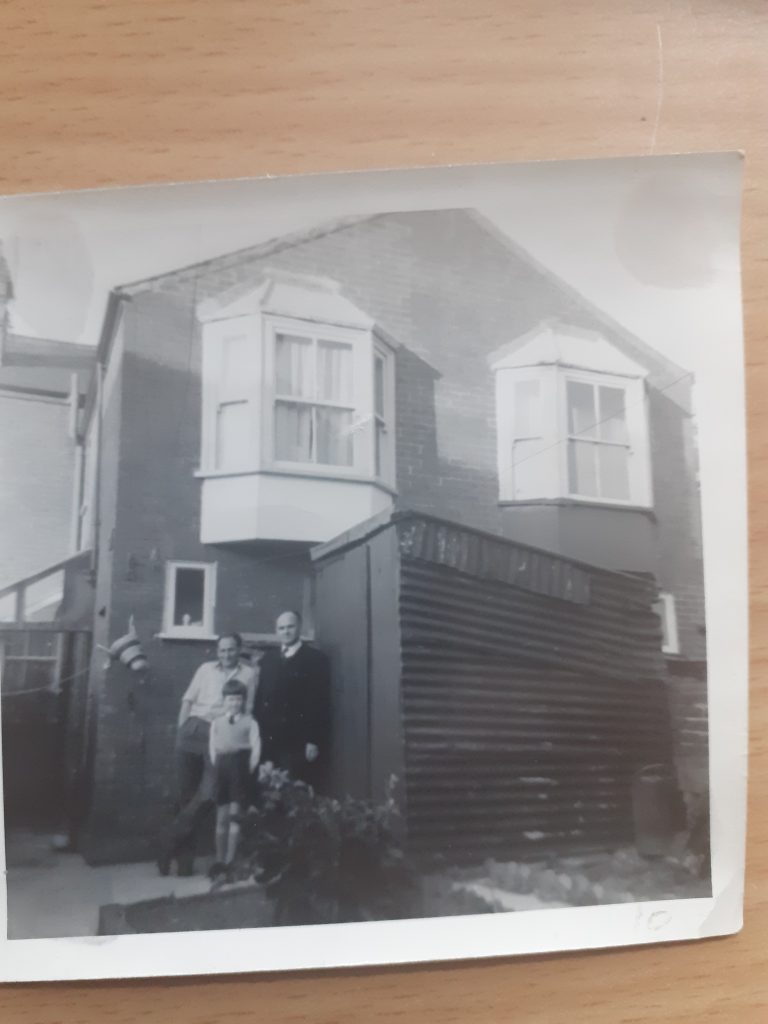
Modelling has never been just a hobby for me. It has been a thread running through my life, a way of reclaiming autonomy, of finding joy and dignity in small acts of creation. Over the years, it has become part of my identity, part of my testimony, and even part of my Father’s story. Some of my dioramas now sit alongside his memoir, as if the craft itself has become a continuation of his archive – memory preserved in plastic and paint.
The Skyhawk: Autonomy in Constraint
It began in earnest in my thirties, when I was living with my Father and later became his carer. Life then was narrow, constrained, with little autonomy. The house itself seemed frozen in time, and I was not allowed to change or renovate it. In that atmosphere, the smallest act of choice felt like rebellion.
One day, in Exeter’s Toy and Pram shop – a place of childhood Christmases and wonder – I saw the Fujimi 1/72 Skyhawk in sand and green. Money was tight, but I bought it. I had Humbrol enamels, thick as treacle, and no airbrush. The decals left water stains, the paint went on heavy. It looked nothing like the magazine models. And yet, it was mine. Unlike so much else in my life then, it was not dictated by my Father. That Skyhawk was the beginning of reclaiming autonomy, of carving out space for myself.
The Ju‑88: A Symbol at the Heart
Long before the Skyhawk, there was Bradford. I was eight or nine, travelling north on the M1 with my Father in a rented car – an old banger with a hole in the floor, through which my sister and I gleefully dropped banana peels, watching the mystified faces of drivers behind us. We had gone to visit his Ukrainian friends; there was a large Ukrainian community in the city then. For my Father, this was familiar ground – he was used to exiles and foreigners of all sorts. But for my sister and me, children of Ukrainians growing up in insular Devon in the 1960s, it was a shock. Exeter was a sleepy backwater then, where it was rare to meet non‑Europeans. Bradford felt like alien territory: soot-blackened buildings, cobbled streets, curry drifting from Asian shops and houses. We were so unprepared that we almost hid low in the back seat, wide‑eyed and uneasy at the landscape.
Perhaps the absurdity lay not in Bradford itself, but in the journey. While most families in those days streamed south‑west for their holidays, to the coasts or moors of Devon and Cornwall, we conducted our trek in the opposite direction – into the industrial north, into exile fellowship, into a world that felt back to front. Years later, I laughed when I saw Porridge, and Fletcher’s line about MacKay’s curry expertise: ‘India? No, Bradford!’ The joke captured exactly what we had felt – Bradford as bewildering, alien, and yet, in retrospect, tinged with absurdity.
In Woolworths, my Father – in rare holiday generosity – bought me the Airfix Ju‑88 in 1/72 scale, light blue plastic, box art glowing with promise. For me, it was a jewel, a rare gift, a chance to share something with him.
But when I asked for help, he was brusque, impatient, his hands unsteady – nerves shattered by war. I returned to the instructions, sensing something was amiss. The wings had been glued on backwards! His solution was obvious to him: hack them off with a kitchen knife and glue them back on. He thrust the wounded plane back at me. I was devastated.
That ruined model embodied the contradiction: on one side, my Father – an exile brutalised by war, desperate to seize those rare moments of connection with his Ukrainian friends, still dreaming of return, unable to give the care and patience I longed for. On the other side, little Michael- full of wonder at the box art, yearning for tenderness, bewildered by brusqueness, crushed when the wings went on back to front. The Ju‑88 became the scar of that moment – a plane with back‑to‑front wings, carrying both his trauma and my heartbreak.
And yet, it was also the seed of something enduring. From that day, I vowed to treat models with care, to build with patience, to give dignity to what my Father could not. Every model I have built since carries that vow. Each careful decal, each steady brushstroke, is an act of healing – testimony that brokenness can be transformed into resilience.
Interlude: The Jagd Tiger
It was Christmas in Exeter, in the magical Toy and Pram shop. I was overwhelmed by the shelves of model kits, and on the top sat the Tamiya 1/35 Jagd Tiger, its box art filling my child’s eyes with wonder. I wanted it desperately, though I knew it must be too expensive. To my astonishment, my Father bought it for me.
I tried to build it, and managed the assembly, but the painting stage brought heartbreak. I had no knowledge of German camouflage colours, and when the instructions said dark brown and dark yellow, I reached for the only enamel paints I had. The result was a diseased patchwork of bright brick red over lemon yellow splotches. I could not ask my Father for help; he would not have understood. So the Jagd Tiger was abandoned in a dark corner of shame of my wardrobe, a permanent reminder of what could have been.
A few years ago at a model show, I bought that same Airfix Ju‑88 from Bradford days. It seemed so small now, but I keep it in my stash, unsure whether to build it or simply preserve it as memory.
Modelling as Testimony
From those beginnings – the ruined Ju‑88, the diseased Jagd Tiger, the imperfect Skyhawk – grew a craft that has sustained me through caregiving, through work, through Covid, and into today. Over time I learned varnishing, decals, airbrushing. Now I can build to a high standard. But the meaning has never been in perfection. It has always been in the act: the ritual of climbing the stairs to my modelling room, the sanctuary of that space, the testimony of resilience.
Modelling became part of me, part of my life, and even part of my Father’s memoir. Some of my dioramas now sit alongside his story, as if the models themselves are witnesses – fragments of memory, crafted with care, carrying forward the dignity of both our lives. His words preserve the past; my models preserve the witness of living through it. Together, they form a dialogue across generations: memory and craft, archive and testimony, Father and son.
And yet, my care and meticulousness did not come from him. They came from my Mother, a Ukrainian Hutsulka, whose embroidery was intricate and wondrous. From her I inherited the attention to tiny details, the patience to dignify small things. Where my Father’s hands were shattered by war, hers created beauty stitch by stitch. In my modelling, I carry both legacies: his brokenness and exile, her artistry and care.
So each model I build is more than plastic and paint. It is a dialogue between them, and within me: a Father’s memoir of survival, a Mother’s embroidery of beauty, and my own testimony of resilience.
The Airfix Ju‑88. Once five times bigger in a child’s eyes, now a relic of memory. It carries the contradiction at the heart of my life: a Father’s shattered nerves and exile, a son’s longing for care. Its back‑to‑front wings remind me that brokenness can scar, but also seed resilience.
In his Guide to the Slavonic Languages, DE Bray writes with deep erudition and human sympathy about the intricacies of the Slavonic languages, and about the cultural and historical contexts that shape them. His words remind us that language is more than grammar or vocabulary; it embodies a worldview, a set of assumptions about life, society, and human possibility.Published in 1951.
I recently came across a remarkable find: Guide to the Slavonic Languages by R.G.A. DE Bray, a lecturer at the institution I once studied at, though long before my time. Even for someone like myself, who is not a scholar of Slavonic languages, it is a treasure trove. The book resonates on many levels: it speaks of a gentler, more refined era, when scholarship was exacting and the pursuit of knowledge meticulous.
It is a mammoth work, which gives a summary of every language of the Slavonic group: Old Slavonic (Old Bulgarian), Russian, Ukrainian, Byelorussian, Bulgarian, Macedonian, Serbo-Croatian, Slovenian, Czech, Slovak, Polish, Lusatian (or Wendish).
The Hidden Heroine
In his Preface, DE Bray writes: “It gives me pleasure also specially to mention the tireless help, encouragement and expert criticism of my wife, who also performed the stupendous feat of typing the entire work in preparation for printing. her knowledge of several Slavonic languages and her understanding and sympathy with the aims of my work enabled her to make valuable suggestions in shaping the book.
I would also like to thank my publishers, Messrs. J.M. Dent and Sons, Ltd., for their endless patience and unfailing encouragement in the writing of this work over a period of seven years and under various difficult circumstances.”
DE Bray’s indefatigable wife really does emerge as the unsung heroine here. Just imagine the ordeal: seven years of typing the entire manuscript, a task that must have been Herculean given the diacritics and unfamiliar alphabets of Slavonic languages – all on a manual typewriter, with no digital shortcuts. Her “stupendous feat” wasn’t just clerical; her own knowledge of Slavonic languages meant she was actively shaping the book, catching errors, and offering suggestions.
One imagines her at the typewriter, clacking away under blackout curtains, doodlebugs flying, the outside world collapsing, determined that the manuscript should be finished.
It’s a reminder that scholarship is often a partnership, yet he never even mentions her by name-a silence that makes her contribution all the more invisible.
And then that closing line – thanking the publishers for their “endless patience and unfailing encouragement… over seven years and under various difficult circumstances.” It is classic British understatement. “Difficult circumstances” likely meant wartime disruption, rationing, perhaps even bombs falling nearby. Yet the manuscript had to be finished. Scholarship as endurance, almost defiance: the book must go on, even in the shadow of war.
It is easy to see why I feel a kinship with DE Bray. That mixture of meticulous devotion, quiet humour, and sheer stubbornness, or perversity, in the face of adversity is very much in tune with my own witness.
I didn’t have a hidden heroine; I have my digital helpers, a blinking cursor in Word, now joined by AI to help refine and carry forward my great archive. And my nephew too, of course. Different eras, different tools, but the same devotion to finishing testimony – whether under bombardment or beneath the quiet glow of a screen.
However, DE Bray sets out to give the student not merely technical knowledge of languages, but a pathway into understanding the cultures, literatures, and histories that they embody. His work reminds us that language is inseparable from the worldview it carries, and that careful, attentive study opens a window into the lives, values, and sensibilities of others.
Finding this book, unexpectedly, among the shelves of Oxfam, was a reminder that the past still offers treasures, and that these treasures can illuminate both history and our contemporary understanding of the world.
DE Bray writes:
The ultimate aim of this work is to enable a direct and reliable approach to be made to the wider issues reflected in the Slavonic literatures and their background, through an accurate knowledge of the Slavonic languages, and so help to create true understanding and friendship between the Slav peoples, great and small, and the English-speaking world. The student is urged always to have those ‘wider issues’ in view and to remember that even an accurate translation, if it is torn from its context and background, can be totally misleading and distort the truth. To know the reality, truth and beauty of the Slavonic world is an unforgettable experience. It enriches and brings hope. (xxiv).
Reading these words now is poignant and sorrowful. The conflict between Ukraine and Russia reminds us how fragile such understanding can be, and how easily shared history and culture can be shattered. DE Bray’s admonition about context and the deeper issues behind language is a lesson not just for translators or linguists, but for anyone seeking to comprehend the unfolding human tragedies around us. In a world where superficial familiarity is often mistaken for true understanding, his ideal – that knowledge of language can bridge peoples – is both more urgent and more elusive than ever.
DE Bray closes his discussion with a short epigraph in Ancient Greek, which I believe means something like: ‘Behold it, as you hope for much, and rightly so’.
For most modern readers, the letters are opaque, but the sentiment is immediate and uplifting. In context, DE Bray is urging the student to approach the Slavonic world with care, attention, and hope: to see its richness in full, to respect its complexity, and to seek understanding that is faithful to its context. It is a call to notice, to engage, and to value what is genuinely there, rather than what might superficially appear.
This epigraph resonates deeply with my reflections on language, culture, and the current conflict in Ukraine. DE Bray reminds us that knowing a language is not just about words or grammar; it is about accessing the worldview embedded in that language – the history, values, and assumptions that shape thought and action. Superficial familiarity is not enough: one must “behold” the reality fully, in its texture and depth, if one hopes to understand it.
In the Soviet Union and post-Soviet Russia, I saw a world shaped by material obsession and dehumanisation, whose meanings are not always legible to outsiders. Misreading those signals, or assuming that imported forms automatically carry the underlying values, is much like the “cargo cults” a Ukrainian friend described: appearances of Westernization without the cultural infrastructure to sustain them. DE Bray’s epigraph becomes a guiding principle: see fully, with context, and hope rightly. Only by doing so can one appreciate the true stakes in Ukraine, and the urgent need for understanding, engagement, and moral clarity.
Even if you cannot read Ancient Greek, the letters themselves are a striking reminder: understanding a culture requires more than a superficial glance. De Bray urges us to engage fully, to see the richness behind the words, and to approach language – and by extension, a society – with care and attention.
Epigraph: A Call to See
From R.G.A. DE Bray,Guide to the Slavonic Languages
Translation: “Behold it, as you hope for much, and rightly so.”
This lesson is urgent in the context of Ukraine. Language, culture, and history shape how societies act and understand the world. Superficial familiarity or mimicry, like the “cargo cults” analogy, can mislead. De Bray’s epigraph is a call: see fully, respect context, and hope rightly – principles that guide how we must engage with Ukraine today.
Historically, the Ukrainian language faced repeated suppression. As DE Bray notes, even in the 18th and 19th centuries, Ukrainian was “still not generally recognized as a separate language”. Even the Czech scholar Josef Dobrovsky, the founder of modern Slavonic studies, refused to recognise Ukrainian as anything more than a dialect of Russian – a perspective that would have pleased modern Russian ethnonationalists. Under the Tsars, the language was actively constrained: in 1863 it was forbidden as a language of instruction in schools, and in 1876 the printing and publishing of proper Ukrainian was banned. Only texts printed in Russian orthography were allowed, mockingly nicknamed yarizzhka, the “messenger boy’s spelling.” It was not until 1905, with a new constitution, that these restrictions were lifted and Kyiv regained its place as the cultural centre of Ukraine.
This history underlines that the current conflict is not simply geopolitical or military; it is also a struggle over identity, language, and the right of a people to define themselves culturally and politically. For centuries, Ukrainian linguistic and cultural expression has been constrained by external power, and the echoes of those policies still resonate in the ideologies driving Russia today.
DE Bray also draws attention to the extraordinary resilience of the Ukrainian people during the Second World War:
“In the recent war, Ukraine suffered and was devastated as terribly as any land in Europe and her people were stirred to superhuman efforts. These will doubtless leave their traces in subsequent Ukrainian literature and in the development of the language. The student can be encouraged to explore the new literature and keep his mind sympathetic and open.”
The irony is bitter today: in Putin’s rhetoric, Ukrainians are dismissed as “Nazis,” their heroism erased, their sacrifices denied – a cruel inversion of the reality that De Bray so respectfully recorded. The same people who endured unimaginable suffering and contributed immeasurably to the defeat of Nazism are now subject to narratives that seek to delegitimize their history and identity.
In my own time in Kyiv in 1981–82, Ukrainian was rarely heard in the capital; it was largely confined to homes or more rural areas. Yet despite decades of political and cultural pressures, the language endured, quietly awaiting conditions in which it could flourish once more.
Language, Empathy, and Endurance
For contemporary readers, De Bray’s work offers more than linguistic insight. It is a meditation on empathy, on the patience required to see and appreciate another culture on its own terms. It reminds us that languages carry with them histories, values, and experiences that cannot be reduced to mere words. In the case of Ukraine, his reflections illuminate both the fragility and the resilience of a language and people who have endured centuries of suppression, yet whose identity and culture persist.
In a world too often shaped by superficial understanding, quick judgments, and narratives that erase complexity, DE Bray’s scholarship offers a model: careful observation, contextual awareness, and the hope – rightly placed – that attentive study can foster genuine comprehension and friendship across cultures. His book is a treasure not only for students of Slavonic languages, but for anyone seeking to understand the enduring human and cultural threads that connect past and present, and that make witnessing, recording, and appreciating another people’s experience an ethical imperative.
It is all the more remarkable when one considers the context in which DE Bray was working. Most of the Slavonic-speaking world was, at the time, behind the Iron Curtain, with travel and access restricted, information tightly controlled, and scholarly exchange severely limited. Even in my own time, decades later, hearing Russian spoken outside small communities of exiles in the UK was extremely rare.
To devote oneself so fully to these languages, to master such a diversity of forms, and to continue this work through the upheavals of the Second World War, is simply breathtaking. DE Bray was a scholar of the first order: rigorous, passionate, and extraordinarily committed to the pursuit of understanding across linguistic, cultural, and historical boundaries. His work reminds us that true scholarship is not merely technical proficiency, but also patience, courage, and a deep respect for the human worlds those languages express.
I have met scholars of a similar calibre at the institution where I studied, and it is profoundly humbling. You arrive at eighteen thinking you know quite a bit, only to find yourself in the presence of people whose depth of knowledge, precision, and intellectual dedication makes your own learning feel miniscule by comparison. Not all of them, however, were as humanistic, sympathetic, or warm as DE Bray appears to have been. Dedication to a subject can sometimes come at the expense of empathy or feeling, and I witnessed scholars who seemed almost removed from humanity, brilliant yet austere.
The extraordinary balance – total commitment to a field while keeping the human always in view – is rare, and DE Bray seems to embody it. For me, this is why, at the end of the day, I would always return to my Father. He restored my belief and filled me with warmth, compassion, and humanity – the same qualities that scholarship, at its best, ought to nurture. This is part of what language, and the study of it, should ultimately be about: connecting minds and hearts, and keeping the human in focus amidst the rigour of learning.
Sign-Off: Continuity and Reflection
This entry sits alongside my reflections on my Father’s memoir and my observations of Ukraine today. While the political and historical realities of conflict demand urgent attention, the patient work of understanding language and culture reminds us that human experience is layered, enduring, and often paradoxical. DE Bray’s scholarship invites us to slow down, to see the world through different lenses, and to recognize the resilience of those whose voices might otherwise be suppressed. It is a reminder that witnessing and recording – whether through memoir, essay, or careful study – is itself a form of engagement, a bridge between the past and the present, and a way to honour the richness and dignity of human life.
On Russian and the Profanum Vulgus Professor Jopson, quoted by DE Bray, reminds us that Russian belongs among the “fairest company” of world languages, though the profanum vulgus – those uninitiated in Cyrillic – cannot be expected to feel its greatness. Yet even the outsider, hearing Russian spoken for the first time, may be struck by its melody. The divide between scholar and layman is real, but not impermeable.
And perhaps, with a smile, I should admit that most of us – my friends and family included – belong to the profanum vulgus. It is no insult, but a reminder that beauty in language can reach us even when we stand outside the temple of scholarship.
The Roman poet Horace famously wrote “odi profanum vulgus et arceo” – “I hate the unholy rabble and keep them away.”
DE Bray’s whole project was to show that every Slavonic language – Ukrainian, Belarusian, Czech, Polish, Lusatian – deserved careful study, not just Russian. By including Jopson’s classical phrase in the Russian chapter, he acknowledges the elitist tradition of philology, but he also gently resists it by giving equal dignity to the “lesser” tongues.
Here is Jopson waxing in full classical register: “Whether it is the wealth of the Russian vocabulary that attention is focused on, or the nobility of expression and the harmony of the language, it is generally recognized that Russian can hold its own in the fairest company. Those who belong to the profanum vulgus, to whom the Cyrillic alphabet, however attractive to the eye, is a mystery, cannot of course be expected to feel the greatness of the language. It is nevertheless a matter of common experience that a person completely ignorant of Russian, who for the first time hears the language spoken by a native, will involuntarily exclaim: ‘Why, how melodious Russian sounds – I always thought it was so hard, nothing else but a succession of long syllables, of unpronounceable words’. Nothing is falser than so unflattering a judgement, for once a learner has sufficiently overcome the difficulties of the language to be able to understand it when spoken, and to appreciate, dimly perhaps, but still appreciate, the written word of the great writers, his admiration increases till he is unrestrainedly ready to subscribe to the touching and famous words of one of Russia’s noblest writers”.
Then he quotes Turgenev: “in days of doubt , in days of painful reflection on the fate of my country, you alone give succour and support to me, o great, mighty truthful and free Russian tongue. Were it not for you, how should one not fall into despair when seeing all that is taking place at home? But it is impossible to believe that such a language was not given to a great people”.
“В дни сомнений, в дни тяжёлых раздумий о судьбе моей родины, ты один мне поддержка и опора, о великий, могучий, правдивый и свободный русский язык! Не будь тебя – как не впасть в отчаяние при виде всего, что совершается дома? Но невозможно верить, чтобы такой язык не был дан великому народу.”
Turgenev’s words carry a cadence and music that English translation can’t quite capture. Russian has those long vowels and flowing consonant clusters that make even solemn lines sound lyrical.
For example, the opening phrase “В дни сомнений, в дни тяжёлых раздумий о судьбе моей родины…” has a rhythm that rises and falls almost like a chant. Even without full understanding, the sound conveys gravity and tenderness. That’s why Jopson was so insistent that Russian’s “melodiousness” could be felt even by outsiders – the ear catches something the eye (struggling with Cyrillic) might miss.
V dni somneniy, v dni tyazhyolykh razdumiy o sud’be moey rodiny, ty odin mne podderzhka i opora, o velikiy, moguchiy, pravdivyy i svobodnyy russkiy yazyk! Ne bud’ tebya — kak ne vpast’ v otchayanie pri vide vsego, chto sovershayetsya doma? No nevozmozhno verit’, chtoby takoy yazyk ne byl dan velikomu narodu.
The repeated v dni…v dni, gives it a solemn, almost incantatory rhythm. The rising and falling candence sounds almost like a liturgical chant, especially the sequence pravdivyi i svobodnyy russkiy yazyk.
Jopson’s passage is both amusing and revealing: it shows the old philological habit of drawing a sharp distinction between the ‘initiated’ and the ‘rabble’, while at the same time admitting that language’s beauty can spill over those boundaries.
To us today, Jopson’s rhetoric feels almost comical in its certainty and grandeur, but it reflects the scholarly ethos of the time. Languages were not just studied, they were revered as moral and aesthetic worlds.
This reflection sits alongside my work on my Father’s memoir, which records a life shaped by total war, occupation, and the long moral aftershocks of the twentieth century. While his story belongs to an earlier catastrophe, the war in Ukraine has made it impossible to pretend that those histories are safely sealed in the past.
I write here not as a strategist or politician, but as a witness. I spent time in the Soviet Union, and what I saw then helps me understand what is unfolding now.
What I Saw in the Soviet System
During my time in the Soviet Union, two things struck me with lasting force.
First, an all‑consuming drive for material things. Born of deprivation and repression, people became obsessed with seizing whatever they could, by whatever means. Scarcity warped values until possessions became not merely desirable, but the only solid reality people felt they could rely on. In that environment, material things were not simply a measure of success; they became substitutes for meaning, autonomy, and even survival itself.
This is the crucial distinction from Western consumerism. The point is not that people were more greedy, predatory, or voracious, but that the material became ontological rather than aspirational. When every moral, spiritual, and civic reference point is denied or hollowed out, possession ceases to be a desire and becomes a proof of existence. Corruption networks flourished, black markets thrived, and survival often depended on exploiting others.
I am aware that some readers will respond: but this exists in the West too – rampant consumerism, shallow materialism, the same moral emptiness. The resemblance is superficial. What I witnessed was something more extreme and more deeply rooted.
Under Marxist‑Leninist ideology, the spiritual dimension of human life was not merely neglected but actively denied. Religion, conscience, and transcendent moral limits were treated as illusions or threats. When material conditions are proclaimed as the sole reality, then material acquisition becomes the only rational goal. Ends justify means. Scruples are luxuries.
I remember one small, chilling moment that fixed this truth in my mind. A Soviet official who constantly monitored us – we called him Tato Volodya, “Daddy Volodya” – wore a long black leather coat that reminded me, even then, of the Gestapo. The nickname was meant to sound familiar and caring, as though he were a guardian, a sort of paternal figure. The contrast could not have been starker: he was merely a functionary, a cog in a system devoted to control and surveillance. One day he deliberately fingered the coat and said to me, “You see this, Misha?” touching the leather, “THIS is what we believe in.” He said it with a knowing smirk – the same patronising expression I see today in Vladimir Putin. It sent a chill through me. A human being reduced himself to a coat. Yet that, unmistakably, was where value truly lay.
The great irony is that in the land that claimed to abolish alienation, human beings were more alienated than anywhere else – turned into objects of total control, stripped of inner life, and measured only by what could be possessed, displayed, or enforced.
When the Soviet Union collapsed, this moral vacuum did not heal – it widened. The ideology imploded, but nothing replaced it. What followed was not freedom tempered by law, but rampant lawlessness: the plundering of state assets, gangster capitalism, and the fusion of criminality with power. Out of that chaos emerged a hunger for order at any cost.
Putin’s authoritarianism did not arise in opposition to this culture, but as its heir. In many respects, Russia simply returned to form – rule by force, sanctified by material power, with human dignity once again expendable.
Second, a profound erosion of humanity. I witnessed men beaten half to death in public spaces, chased and humiliated like animals. Violence, intimidation, and ruthless self‑interest were normalised. Compassion, dignity, and restraint were stripped away by a system that rewarded brutality.
These experiences were not aberrations. They were systemic. They were the moral DNA of a political order that trained people to abandon dignity in order to survive.
Putin: Not an Anomaly, but a Product
Vladimir Putin emerged from this world. His worldview bears its unmistakable imprint:
Material obsession: power defined by control of territory, resources, and wealth.
Institutionalised corruption: networks of privilege and exploitation elevated into a governing system.
Dehumanisation: politics conducted through intimidation, violence, and the denial of human worth.
When Margaret Thatcher said she “looked for the humanity” in him and found none, that absence was not accidental. It was the logical outcome of the system that shaped him.
Putin is not a historical aberration. He is continuity – the Soviet moral economy translated into a modern authoritarian state.
This continuity is institutional as well as moral. Russia today remains profoundly shaped by the FSB security services – the direct heirs of the KGB. Far from being marginalised after 1991, these organs exploited the chaos and failures of the post‑Soviet democratic experiment to reassert themselves behind the scenes. Formal political institutions survived, but real power increasingly migrated to opaque networks of surveillance, coercion, and control. Putin’s rise did not mark a break with this culture; it marked its consolidation. In this sense, Russia did not so much abandon its past as return to form.
Ukraine: The Fault Line
Putin’s war against Ukraine is not a sudden deviation or a reactive response to NATO. It is the culmination of decades of values forged in repression:
the belief that borders can be redrawn by force;
the conviction that material power outweighs human lives;
the willingness to crush dignity and freedom in pursuit of dominance.
Ukraine stands at the fault line between two incompatible worlds: one in which people are expendable instruments of power, and another in which dignity, freedom, and self‑determination matter.
This is why Ukraine has become pivotal. Its struggle is not marginal or regional. It is civilisational.
Scepticism in a British Context
In Britain, scepticism about supporting Ukraine often presents itself as pragmatism or war‑weariness: talk of avoiding entanglement, conserving resources, or focusing on domestic priorities. These concerns are understandable in a country shaped by the memory of Iraq, Afghanistan, and imperial overreach.
But much of today’s scepticism also rests on familiar false narratives: that NATO “expanded aggressively,” or that the West seeks to “defeat Russia strategically.” These are not neutral analyses. They are the refined products of a propaganda tradition perfected in the Soviet era and inherited by modern Russia.
The aim is unchanged: to sow doubt, fracture alliances, and weaken resolve. Confusion becomes a weapon. Moral exhaustion becomes a strategy.
I recognise these techniques because I saw the system that produced them.
Why Support Matters
Supporting Ukraine is not charity. Nor is it about humiliating Russia. It is about recognising what is at stake:
It is a defence of humanity against a system that denies it.
It is a defence of freedom against a worldview that treats people as tools or prey.
It is a test of whether Europe has learned anything from its own history.
The echoes of the 1930s are unmistakable. Then, hesitation and appeasement emboldened aggression. Today, scepticism risks repeating the same mistake under new slogans.
This is no longer merely a matter of historical interpretation. Britain’s own intelligence leadership has issued stark warnings about the present danger. In her first public address, the head of MI6 described Russia under Putin as an aggressive and revisionist power posing an acute threat to European security – a threat likely to persist as long as the current system endures. Such assessments underline that the war in Ukraine is not distant from British interests. It is already shaping the security environment in which this country must live.
If Ukraine falls, the vice tightens around Europe. The moral lesson of “never again” is inverted into “again, but worse.”
Closing Reflection: Why This Matters Here
For a British audience, Ukraine may feel distant – another European crisis layered onto many others. But Britain’s own history should make the stakes intelligible. This country understands, perhaps better than most, the cost of confronting aggression too late rather than early.
I saw the roots of this system decades ago. Today, those roots have borne fruit in the destruction of Ukrainian cities and lives.
Putin’s war is not an accident of geopolitics. It is the logical extension of a culture shaped by material obsession, corruption, and the absence of compassion.
To support Ukraine is not to choose conflict; it is to choose self‑preservation. It is a stand against the return of a world in which humanity is expendable and power is the only truth.
It all started with a Heinkel He 111 in 1/35 scale. Looking at CAD images of the model kit, I found myself squinting at the stressed skin, wondering whether the exaggerated oil-canning was realistic – or whether the designer had simply gone a little overboard. From pieces of plastic, a bit of rivet detail, and suddenly my thoughts were racing far beyond the plastic model, from the miniature imperfections to reflections on the excesses of our entire society. In a funny, almost comic way, this single kit became a lens through which I began to understand bigger truths: how ambition, enthusiasm, and disregard for limits can scale up from a hobby to the planet itself.
I came to realism the long way round.
As a lifelong modeller, I began – like most people in the hobby – by being seduced by ambition. Bigger kits, finer detail, more dramatic surface effects, the promise that this one would finally capture reality in miniature. For years, the heart led and the head followed, if at all. Experience, however, is a patient tutor. Over time it taught me something counterintuitive: realism is not achieved by adding more, but by knowing when to stop.
That lesson did not arrive all at once. It came through misaligned parts, ruined canopies at the final hurdle, decals that silvered despite every precaution, and projects that quietly returned to their boxes unfinished. Eventually, enthusiasm learned to submit to judgement. The question ceased to be can this be done? and became should it be done at all? Measured realism – restraint, proportion, credibility – replaced spectacle.
Only later did I realise that this private evolution mirrored something much larger.
Today’s modelling culture increasingly celebrates excess. Enormous kits in awkward scales, hyper-exaggerated surface textures, detail piled upon detail until the object ceases to resemble the real machine it claims to represent. The intention is authenticity; the result is often distortion. Yet the appetite for more – more size, more parts, more drama, more novelty – seems insatiable.
It is hard not to see this as a reflection of the world beyond the workbench.
We live in a culture that mistakes accumulation for meaning. Cities choke with traffic, vehicles grow ever larger while carrying fewer people, shops overflow with goods destined for the landfill weeks later. Seasonal rituals of consumption are performed with quasi-religious fervour, even as we acknowledge – at least verbally – that the planet cannot sustain them.
This is why the behaviour feels unbalanced and unhealthy. Civilisations that believe in a future tend to build infrastructure meant to last, accept limits, and think in generations rather than quarters. Civilisations that do not tend to strip-mine their own foundations.
What is striking today is the disappearance of the future as a moral reference point. We are living through a profound shift in temporality – a collapse into what might be called presentism. Strategy, properly understood, implies long-term goals, patience, and obligations to what comes after us. Increasingly, however, both political and economic life operate as if the future were either radically diminished or no longer real.
Diplomacy, especially in its current American variety, offers a telling example. Where it once implied relationships built over time, trust accumulated slowly, and compromise sustained across decades, it is now often framed in transactional terms. Deals replace alliances; leverage replaces understanding. Even national security strategies read less like visions of continuity and more like balance sheets: what can be extracted, secured, or traded now. Foreign policy becomes a form of business conducted in the present tense.
Seen from this angle, consumer behaviour begins to make a bleak kind of sense. If the future no longer commands belief, restraint becomes irrational. Why conserve resources for a world one does not feel answerable to? Why accept limits when limits presuppose continuity? The feeling I had so strongly recently – of people behaving as though there were no future, and therefore needing to spend now – may not be a misunderstanding at all, but the logical culmination of a long historical development.
Nietzsche suggested that civilisation is a collective fantasy. If so, ours is a fantasy sustained less by belief than by momentum. We continue to act as though the future exists, while behaving in ways that quietly deny it. The contradiction produces a peculiar moral hollowness: motion without direction, consumption without confidence, power without purpose.
There is a story – widely repeated, and revealing regardless of its precise wording – of a political leader being asked whether reliance on finite fossil fuels was a concern. The reply was that it did not matter; by the time those resources ran out, he would no longer be around. Few remarks better capture the spirit of the age. It is not merely selfishness, but the explicit abandonment of intergenerational responsibility.
The planet is finite – materially, energetically, ecologically – yet we continue to behave as though finitude were an inconvenience rather than a boundary. We speak of sustainability while structuring our lives, economies, and politics around perpetual expansion. This is not a balanced or healthy trajectory; it is a self-destructive one.
Returning to modelling, the analogy becomes inescapable. The experienced modeller learns that not every kit should be bought, not every innovation embraced, not every surface worked to exhaustion. Energy, money, space, and time are finite. Satisfaction comes from choosing carefully, finishing well, and recognising when admiration from a distance is enough.
In this sense, measured realism is not only an aesthetic position but an ethical one. It accepts limits without despair. It values continuity over spectacle. It assumes – quietly but firmly – that the future matters, even if one may not personally inhabit it.
Civilisations, like models, cannot be built on excess indefinitely. At some point the structure warps, the joins fail, and detail overwhelms form. Whether we rediscover restraint at a collective level remains an open question. But at the individual level, one can at least refuse to confuse more with better, or immediacy with meaning.
That refusal may be modest. It may change nothing at scale. Yet it preserves something essential: the idea that realism – measured, finite, and conscious of what lies beyond the present – still has value in a culture increasingly determined to forget it.
1. Oxfam Discovery: A Tangible Connection to the Soviet Past
It was in Exeter’s Oxfam second-hand bookshop – almost my second home – that I recently stumbled upon a worn copy of The History of the Military Art by E.A. Razin, Volume II – part of the three-volume Soviet classic printed in 1957 (Istoriya Voennogo Iskusstva, Voennoe Izdatel’stvo Ministerstva Oborony Soyuza SSR, 1957). The cloth binding was a little tatty, its pages slightly loose and faintly musty, and inside was even a wafer-thin receipt stamped with a price in roubles! I wondered what odyssey this book must have taken to find its way to Exeter in 2025 – perhaps from the library of a Soviet officer of the Stavka, the Soviet General Staff. For a moment I hesitated, tempted to buy it despite the exorbitant price, drawn less by the text itself than by the object – a relic of a vanished world. To hold it was to feel once again the strange allure that the Soviet Union held for me in my youth: the austere scholarship of its military theorists, the dog-eared volumes of Marx and Clausewitz that once lined the shelves of London’s Russian bookshops, the hope that ideas could explain the cataclysms of history.
2. Geography, Nomads, and Strategic Context
The strategic environment of Russia has long shaped its history and military thought. Located on the vast northern Eurasian plain, with few natural boundaries to defend, the country has always faced the necessity of projecting military power across enormous distances. This geography has conditioned both its generals and its historians: security concerns often dominate, sometimes to the detriment of peaceful civilian development.
As Razin shows in meticulous detail, the succession of nomadic invasions – above all by the Mongols – repeatedly challenged Russian principalities. Yet there is a notable tension in his framework: the Asiatic steppe armies, lacking a settled economic base, succeeded through mobility, discipline, and highly efficient organization. They could achieve devastating operational effects, but ultimately could not establish the deep, sustainable military systems that a developed economic base permits. Razin’s method, emphasizing material conditions as the primary determinant of military outcomes, must therefore interpret such exceptional forces as strategically limited phenomena.¹
3. The Militarized Soviet State
The strategic and social environment of the Soviet Union itself illustrates Razin’s insight in practice. Unlike premodern states, the USSR was a militarized society, geared explicitly for the possibility of total war. Stalin’s five-year plans were not only exercises in economic planning but in strategic preparation: heavy industry, transportation networks, and the urban workforce were all developed primarily to support defense needs. In effect, the Soviet state was building a material base that had not yet existed, in order to produce an armed force capable of defending it — a kind of self-justifying loop in which industrialization, military doctrine, and strategic necessity reinforced one another. Razin’s analysis of historical armies as products of their productive base thus acquires an immediate, almost prophetic resonance in the context of the USSR: theory and praxis converged in a single, massive effort to create both the means and the instruments of modern warfare.²
4. Razin and the Marxist-Dialectical Framework
Razin’s History of the Military Art was conceived as a vast synthesis — a Marxist interpretation of warfare from antiquity to the Second World War. Written in the high Stalinist idiom of “scientific socialism,” it opens with the requisite citations from Marx, Engels, and Lenin, yet these were not mere formulae. They formed the scaffolding of Razin’s method. For him, the art of war evolved in accordance with the productive base of society: its economy, its technology, its social relations of class and labour. The rise and fall of military systems mirrored the dialectic of historical development itself.³
Razin’s framework extended Lenin’s revision of Clausewitz’s dictum that “war is the continuation of politics by other means.” Clausewitz had written as a soldier of the early bourgeois age, for whom war was an instrument of state policy; Lenin redefined it as the continuation of the class struggle by violent means. Razin, following this line, saw war not as an autonomous art but as a social process, the violent expression of contradictions already latent in the economic structure of its time.
From this standpoint, he drew a sharp distinction between “progressive” and “reactionary” wars. The English Civil War, he wrote, was progressive because it overthrew feudal absolutism and cleared the path for capitalism; the Crusades, by contrast, were reactionary, entrenching the feudal order under the guise of faith. History, in Razin’s telling, moved not through the genius of great commanders but through the collision of material forces. “Alexander, Caesar, and Napoleon,” he observed, “could not have achieved what they did had not the objective conditions of their age made it possible.” Victory, in the end, depended on objective conditions, not on the accidents of leadership.⁴
5. Interwar Soviet Thinkers and Glubokaya Operatsiya
Razin’s intellectual debt to his interwar predecessors was profound. In the 1920s and 1930s, Soviet theorists such as Aleksandr Svechin, Vladimir Triandafillov, and Mikhail Tukhachevsky had attempted to translate Marxist dialectics into operational theory. Svechin defined strategy as an art that must remain fluid, dialectical — never a dogma.⁵ Triandafillov, in his seminal The Nature of the Operations of Modern Armies (1929), advanced the concept of glubokaya operatsiya, the deep operation: a vision of modern war fought not by divisions but by entire productive systems — logistics, industry, and manpower fused into a continuous mechanism of depth and scale.⁶ Tukhachevsky, the “Red Napoleon,” sought to realize that vision through mechanization and mobility before his execution in Stalin’s purge of 1937, a tragedy that silenced much of the early Soviet strategic avant-garde.⁷
Razin’s History, published in the more cautious post-Stalin years, can be read as a veiled rehabilitation of those lost thinkers. Beneath its orthodox surface, it carries forward their essential insight: that the character of war flows from the material and technical base of society. The early disasters of the Great Patriotic War — the immense losses of 1941–42 — only confirmed this. The Soviet Union prevailed not through tactical brilliance but through its capacity to reconstitute its productive base, to shift entire industries beyond the Urals, to mobilize its population and reforge its armies on an industrial scale.
My Father, though he would never have read Razin, intuited something of this truth from his own experience:
“No amount of courage or tactical proficiency could overcome the true engines of modern warfare: numbers, machines, supply lines, and above all, air power. The Wehrmacht and Waffen-SS may have been better soldiers man for man, but they were ultimately crushed not by inferior fighters, but by industrial scale, by logistics, and by the overwhelming firepower of the Allied and Soviet juggernauts.”
6. Divergence from Western Military Thought and Readability
Where Razin and the Soviet dialectical tradition diverged most sharply from Western thought was in their philosophy of causation. The Western theorists of the early twentieth century — J.F.C. Fuller, B.H. Liddell Hart, and their continental predecessors such as Antoine-Henri Jomini — treated war as the domain of timeless principles, a science of manoeuvre, willpower, and generalship. Fuller’s The Foundations of the Science of War (1926) and Liddell Hart’s Strategy: The Indirect Approach (1941) prized the autonomy of the commander’s intellect and the moral economy of force. Their theories, though rational and elegant, were ultimately voluntarist: they presupposed that strategic success derived from the enlightened will of the few.
Razin and his Soviet contemporaries rejected this voluntarism outright. For them, there were no universal principles, only historically conditioned laws rooted in the evolving means of production. Military genius could not transcend the epochal limits of the material base; even strategy itself was an expression of the social relations from which it sprang.
What makes Razin’s work especially compelling – and for me personally so enjoyable – is the way it combines clarity, narrative sweep, and scholarly depth. Unlike many Western academic texts, which often become dense, highly technical, or narrowly specialized, Razin’s prose remains readable and integrated. The maps, operational diagrams, and illustrations throughout the volumes are not mere embellishments; they are essential analytical tools, allowing the reader to visualize campaigns, manoeuvres, and operational depth. The maps, especially, give a sense of scale and geography, bringing to life the strategic challenges faced by Russian armies across the centuries.
In this respect, Razin achieves something rare: a work that is simultaneously scholarly, comprehensive, and accessible, bridging the gap between theory and practice, between historical narrative and operational insight. It is a text that rewards careful reading, yet never alienates the reader with unnecessary technicality – a quality that helps explain why it remains a classic in Russian military historiography.
7. Engels, “Marx’s General”
Razin draws extensively on Engels to illustrate the historical development of military organization. Engels, often called “Marx’s General,” wrote in 1855:
“The Roman army … represents the most perfect system of infantry tactics invented during an era that did not know the use of gunpowder. It preserves the preponderance of heavily armed infantry in compact formations, but adds to it: the mobility of individual small units, the ability to fight on uneven ground, the arrangement of several lines one after the other, partly for support and partly as a strong reserve, and finally a system of training for each individual warrior, even more expedient than that of the Spartan. Thanks to this, the Romans defeated any armed force that opposed them, both the Macedonian phalanx and the Numidian cavalry.”
This quotation demonstrates Engels’ deep understanding of military history and organization. His analysis underscores the dialectical relationship between social structures, technology, and military effectiveness, a perspective that Razin adopts throughout his work.
Footnote: Friedrich Engels (1820–1895), often called “Marx’s General,” combined rigorous historical scholarship with practical understanding of military affairs. He analysed armies from antiquity to the modern era, emphasizing the interaction between social structures, economic capacity, and military effectiveness. Engels’ works, including The Armies of Europe (1855), demonstrate his expertise in organization, tactics, and logistics. His analyses informed Marx and provided a framework for understanding war as a socially and economically conditioned phenomenon – an approach that directly influenced Soviet military theorists such as E.A. Razin.
8. The Liberation War of the Ukrainian People (Zaporozhian Cossacks)
Ironically, as I glanced through Volume II, I stumbled upon the section titled “The Liberation War of the Ukrainian People and Its First Period”. This part of Razin’s work deals with the Zaporozhian Cossacks, examining their social organization, military methods, and role in the broader struggle against feudal and imperial oppression.
Razin treats the Cossack campaigns not merely as tactical episodes, but as expressions of popular social forces. He emphasizes how the objective conditions of the time – the economic base, class contradictions, and regional geopolitics – shaped their successes and limitations. The analysis fits neatly within his Marxist framework: military action is a reflection of social struggle, and the ability of the Cossacks to mobilize forces depended on more than charismatic leadership; it depended on the material and social realities of their environment.
For the contemporary reader, the discussion feels strikingly relevant. In 2025, as Ukraine faces new existential challenges, there is a certain historical echo in Razin’s account: war as a continuation of social and national struggle, with military outcomes shaped not only by individual skill or heroism, but by the capacity of communities to organize, sustain themselves, and harness the resources at their disposal. The section is meticulously detailed, with maps, tables, and illustrations that convey both the geography of the campaigns and the scale of the forces involved – elements that make the narrative vividly tangible.
In this sense, Razin’s work is not only a historical account, but also a lens for understanding the enduring interplay of social forces, military organization, and strategic environment, which continues to resonate in the modern context of Ukraine.
9. Cannae, Schlieffen, and the Development of the Art of War
Razin’s analysis of the Battle of Cannae provides a striking illustration of his Marxist-dialectical approach to military history. German theorists of the early twentieth century – particularly Alfred von Schlieffen – canonized Cannae as a “model” for modern warfare, arguing that Hannibal’s tactical envelopment could serve as a blueprint even for contemporary armies. Schlieffen wrote:
“For 2000 years, weapons and methods of warfare have completely changed… But in general terms, the combat conditions remained unchanged. A battle of annihilation can be fought even now according to Hannibal’s plan, drawn up in time immemorial.”
Razin exposes the absurdity of this claim. The scale, technology, and social context of modern armies make a direct repetition of Cannae impossible. Tactical genius alone cannot overcome the material and social conditions of the age. Moreover, Schlieffen misattributes victory to Varro’s incompetence rather than Hannibal’s skill, and inconsistently emphasizes force superiority while simultaneously admiring the Carthaginian outflanking – a contradiction rooted in a voluntarist, enemy-centred perspective.
From Razin’s perspective, the error is clear: war is historically conditioned. Military tactics and operational art evolve with society’s productive forces, technological capabilities, and organizational sophistication. Tactical encirclement in 216 BCE differs in scale, means, and operational context from Sedan (1870) or Stalingrad (1942–43). Cannae is tactical, Sedan operational, Stalingrad strategic – each reflecting the development of warfare alongside societal and economic evolution.
Razin’s critique also illuminates a broader point often overlooked in Western historiography: the Germans’ obsession with Cannae-like encirclements in both World Wars ignored critical material realities. By 1939, Germany’s economic base was too narrow to sustain the grand ambitions of its military planners. Resource shortages, insufficient industrial capacity, and overstretched logistics created inconsistencies and contradictions in strategy. Ideological assumptions – whether notions of racial superiority or the brilliance of German military genius – could not overcome these material limits. In the end, the sheer overwhelming might of their adversaries, particularly after the entry of the United States with its virtually unlimited resources, proved decisive.
Thus, Razin’s lesson is not merely historiographical. It underscores a central principle of his military theory: strategic outcomes depend on the objective material and social conditions, not solely on the genius or will of commanders. The German fascination with Cannae serves as a cautionary tale: historical analogies, if applied without regard to context, can mislead and even endanger armies. Conversely, the Soviet successes at Stalingrad demonstrate how modern industrialized warfare, backed by a robust social and economic base, enables operational and strategic mastery at unprecedented scale.
In short, Razin reminds us that the art of war develops dialectically, from simpler to more complex forms, in tandem with the evolution of society, production, and technology. Tactical brilliance is valuable only insofar as it aligns with material reality, a principle as relevant to historical analysis as it is to contemporary strategic thought.
10. Postwar Doctrine and Contemporary Relevance
After 1945, Razin’s dialectic of war found new expression in Marshal Vasilii Sokolovsky’sMilitary Strategy (1962), which integrated nuclear weapons into the Marxist conception of the “material–technical base.” From there the lineage continued: Ogarkov in the 1970s, emphasizing the “scientific–technical revolution”; Slipchenko in the 1990s, theorizing “sixth-generation” and non-contact warfare; and finally Chekinov, Bogdanov, and Gerasimov in the new century, who reinterpreted the same dialectic under the conditions of hybrid conflict. In each case, the Marxist scaffolding faded, but the materialist instinct endured — the conviction that war, whatever its outward forms, remains a function of the economic and technological substratum of society.
Yet today that substratum is shifting beneath our feet. The categories of Marxist military theory – base and superstructure, productive forces, class content – feel increasingly inadequate to the new terrain of grey-zone conflict, digital manipulation, and information warfare. In the so-called “Gerasimov doctrine,” the boundary between war and peace has dissolved into a spectrum of political, informational, and technological contestation that rarely erupts into open battle. The war in Ukraine has revealed both the persistence and the limits of the old dialectic: industrial scale still decides outcomes, yet digital systems, drones, and data now constitute the new logistics of war.
Beyond that horizon lies something still less tangible. The emergence of artificial intelligence, with its vast appetite for energy and data, threatens to transform not only warfare but the very structure of human labour and knowledge. The productive base itself – once the Marxist foundation of history – is becoming increasingly autonomous, less human. Perhaps in that sense Razin’s dialectic still applies: the means of production, having shaped every previous form of conflict, now reshape the battlefield of the mind.
To handle his book again – the faded paper, the Soviet typeface, the ghost of roubles past – was to touch the afterimage of an age that believed in the intelligibility of history. Whether that faith still holds is another matter. But Razin’s central insight endures: that war, whatever else it may be, remains the mirror of its time – the final, violent expression of what a society has become.
Notes
· Razin, Istoriya Voennogo Iskusstva, Vol. II (Moscow: Voenizdat, 1957).
· Ibid.; also Engels, Anti-Dühring (1878); Lenin, Socialism and War (1917).
· Ibid., Vol. I, introduction.
· A.A. Svechin, Strategiya (Moscow: Voenizdat, 1927; English trans., Minneapolis: East View, 1992).
· Reese, R.R., The Soviet Military Experience: A History of the Soviet Army, 1917–1991 (London: Routledge, 2000), pp. 54–58.
· J.F.C. Fuller, The Foundations of the Science of War (London: Hutchinson, 1926); B.H. Liddell Hart, Strategy: The Indirect Approach (London: Faber and Faber, 1941).
· Sokolovsky, V.D., Military Strategy (Moscow: Voenizdat, 1962); Chekinov, S.G., Bogdanov, S.A., The Nature and Content of Modern Military Conflicts (Moscow: Voyenizdat, 2013).
📚 Availability on Militera.lib.ru
Main page: Разин Е. А. История военного искусства (3 volumes) is hosted in a Russian online library section “Военная литература / Военная мысль.” (militera.lib.ru)
The site gives a “.rar single file” download option, combining volumes. (militera.lib.ru)
There is also a dedicated illustrations (“ill.”) directory preserving maps, plates and visual material. (militera.lib.ru)
Volume II (VI–XVI веков): fully accessible. You can read book-length HTML format of Razin’s second volume. (militera.lib.ru)
The volume includes title, preface, introduction, chapters etc. (militera.lib.ru)
Volume III (XVI–XVII вв.): also available in HTML form. (militera.lib.ru)
This includes preface, content and the chapters in the period of early modern warfare. (militera.lib.ru)
Volume I: The main listing suggests Volume I is also present (it is part of the 3‑volume set). The site’s main page cites the three volumes, including Volume I (earlier periods) in the 3‑volume edition. (militera.lib.ru)
The preface and introductory passages for Volume I are accessible. (militera.lib.ru)
Maps and illustrations: the “ill.” section is preserved separately. You can access the plates, maps, diagrams etc. through that directory. (militera.lib.ru)
Edition: The online text is based on the Polygon edition, 1999 (which is a later reprint) but draws from the original Voenizdat 1955 version. (militera.lib.ru)
Age brings a different kind of vision – you start to see not just the events themselves, but the human cost behind them, especially the loneliness of those left to carry memory on their own. What once seemed like isolated encounters now reveal themselves as fragments of a larger testimony: moments of endurance, compassion, and faith that shine quietly against the darkness.
My life and the archive have never been separate; they have always been one, and now they are fully intertwined. These reflections are gathered here as a supplement to the memoir, carrying forward the image first recorded in Appendix XXIII. The candle in the window is more than a symbol of memory; it is a reminder of the strength it takes to keep humanity alive, whether through compassion for others, courage in suffering, or faith in unseen companionship. Each meditation is part of a living archive, a way of keeping the flame lit so that witness endures.
Reflection : The Old Lady in Podil
In 1982, as a student wandering through Podil, the old quarter of Kyiv by the river Dnipro, I found myself in streets that seemed forgotten by time. Podil, literally the ‘lower area,’ was a district of sagging 19th‑century houses and cobbled lanes carrying the air of a fairy tale. Silence hung over the streets, as though history itself had paused there.
Looking down into a basement window, I saw her: an old woman seated at a table, a single candle burning before her. No sound, no movement, only the flame and her stillness. It was as though time had forgotten her, leaving her stranded between centuries. I thought of the life she must have carried: wars, Stalin, hunger, fear. And yet here she sat, not defeated but enduring, her silence more eloquent than any speech. A vision out of Dostoevsky, preserved in candlelight.
Podil in 1982 was a place suspended in time, behind the iron curtain, where lives like hers were hidden from the wider world. To stumble upon her in that moment was almost like uncovering a secret fragment of history, one that most would have walked past without noticing. I felt a shiver of recognition — a premonition, perhaps, that I too might one day sit alone with only memories for company. But instead of fear, I felt a strange calm. To endure, to remember, to keep the flame alive — was that not also a kind of victory?
This vision, first recorded in my memoir (Appendix XXIII), has stayed with me, and it continues to speak. In these reflections, the candle becomes more than memory: it is compassion for those who suffer alone, and courage to keep humanity alive even when pain tempts hardness. Each meditation is part of a living archive, carrying the flame forward into the present.
Not Alone
Before I ever went to the Soviet Union, I heard a story on the radio that stayed with me. A BBC correspondent described visiting one of those vast, grey tenement blocks in Poland so common behind the iron curtain. The elevators had long since stopped, the place was empty and depressing. Yet in one apartment he found an old woman living alone. When asked if she felt lonely, she replied: “No, I don’t feel lonely at all, because God is always here with me.”
Her faith, rooted in Poland’s Catholic tradition, gave her strength to endure what otherwise would have been bleak circumstances. To hear such testimony was one thing; later, to see it for myself in Kyiv was another. The candle in Podil was a lived reality of the same truth: that even in isolation, humanity and faith can keep the flame alive.
The Cost of Humanity
In a dream I was offered release from pain, even joy, but at the cost of compassion. The bargain was clear: relief would harden the heart, strip away tenderness, and leave me untouched by the suffering of others. I refused, and walked away. That refusal has stayed with me, for it speaks to the deeper truth that memory and witness demand humanity, even when pain tempts us to abandon it. To keep the flame alive is to resist the easy bargain of hardness, and to endure with conscience intact.
History itself shows the contrast. My Father, through suffering, found compassion and humanity. Others, like the ruthless despot who unleashes war without care, have long since lost theirs. To gain the world but lose the soul is no victory at all. The candle in the window is not only memory and identity, but a reminder of the courage it takes to keep humanity alive, whatever harm has been done. It is a fragile flame, yet it endures, and in its endurance lies the strength of witness.