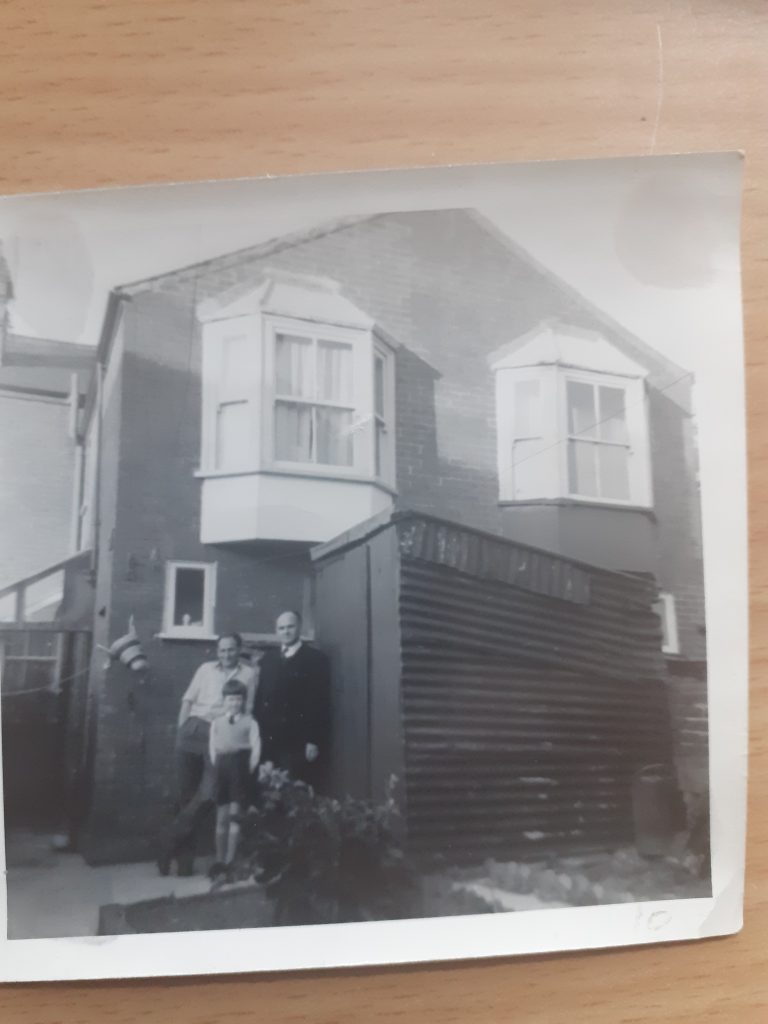
This is an old black‑and‑white photograph I recently returned to. My Father stands beside the shed he built himself – a contraption of corrugated iron and a black asphalt roof that looked like stretched tar. He is dressed in a suit and tie, as if the moment demanded dignity, even though the backdrop was little more than an improvised shelter held together by stubbornness and ingenuity. I stand beside him in shorts, knee socks, and a tie of my own, a small boy dressed up for an occasion I didn’t understand. Behind me, half‑leaning and half‑withdrawing, is my Father’s Ukrainian friend, Ivan Ohloblyn, slouched slightly to one side as if embarrassed by the scene, yet unwilling to step out of it.
That photograph captures a world that has vanished. A world of making do, of improvisation, of people who had survived too much to waste anything. My Father could turn a spoon into a door handle, and did. He built that shed with his own hands, and though it eventually collapsed under the quiet laws of entropy, it lives on in that single image – a symbol of a generation that patched their lives together with whatever materials they had.
I think my Father was never so happy as when he was in his shed, tinkering away. It wasn’t eccentricity – more a form of survival, creativity, and perhaps even a kind of sanctuary.
My childhood was shaped by that spirit. We had little, but imagination filled the gaps which money couldn’t. A folded paper plane could occupy me for hours. A stick and a ball of string became a world.
But scarcity had its sting too. I remember the shame of second‑hand clothes, and the day I was sent to school in grey woollen bib‑front shorts – the sort with a flap and braces that belonged to another era entirely. They made me look like a toddler from the 1930s. I spent the breaks with my arms folded tightly across my chest, hiding the straps instead of playing with the other children. It’s strange how a child can feel both resourceful and exposed at the same time.
And then there was Ivan, part of our small Ukrainian circle in Exeter. He had a forceful manner that could easily tip into overbearing, though beneath it lay a kind heart. He carried himself with a certain bluster, the sort that came more from insecurity than malice– that loud, insistent way some exiles develop, a need to assert themselves in a world that had once tried to erase them.
My Father and Ivan rowed constantly, their voices rising through the house in a language I barely understood. I was witnessing something I couldn’t yet decode: the emotional grammar of exile. I once asked my Father why he bothered with a friend he disagreed with so much. He couldn’t answer me then, but I understand now. They were, in a sense, each other’s mirrors in a foreign land. And sometimes mirrors don’t soothe – they provoke. They remind you of what you’ve lost, what you’ve escaped, what you’re still carrying.
Over time I came to see that the arguments were not a sign of dislike. They were a sign of connection. Two men far from home, bound by a shared past, a shared language, and the simple truth that even a quarrelsome friend is better than isolation.
For men of that generation, especially those who had crossed borders and left families behind, companionship wasn’t about harmony. It was about recognition – about having someone who affirmed your existence simply by being there, even if the way they were there was loud and argumentative.
They shouted not because they hated each other, but because they needed someone who understood the same ghosts. Someone who could push back. Someone who made them feel less alone.
I remember the day Ivan discovered the dark patches on his skin. He was preparing to drive some of the Ukrainians to the annual gathering in Leicester – a jamboree of singing, dancing, and community that I found boring as a child but which meant everything to the adults. The diagnosis was leukaemia. Terminal. He had to cancel the trip. The shock rippled through our small community.
He came to see my Father one last time. I can still see him sitting in the back room, silent, tears rolling down his cheeks. I didn’t know what to say. I said nothing. I only watched, not understanding death but sensing its weight. He had always been kind to me – slipping me two shillings once, a fortune in those days, which I spent immediately on plastic soldiers. Perhaps he felt sorry for me. Perhaps he recognised something of his own childhood in mine.
One by one, my Father’s Ukrainian friends died in those years – men in their fifties who had survived war, displacement, hunger, and trauma, only for their bodies to give out early. Big Ivan, small ‘malyi’ Ivan – all gone. My Father lived on into his eighties, but the circle around him shrank until only one or two remained. For my Father, losing those friends wasn’t just losing drinking buddies or fellow Ukrainians. It was losing the only people who understood the same history, the same wounds, the same language of exile. And without realising it, I became the one left to fill the silence.
Now I sit in the same house, decades later, the shed long gone, the community dissolved, the voices quiet. I am the last custodian of these memories – of men who never returned home, of a childhood shaped by improvisation and embarrassment, of a Father who built things out of scraps and a friend who cried in our back room.
And perhaps that is reason enough to write it down.
But there is something more. I grew up in the shadow of a fear my parents never quite shook – the fear of being erased, of a people scattered until their stories vanished. I used to think that dread belonged to another time. Now I’m not so sure.
When I hear Ukrainians today speak of what is at stake for them – not just territory, but existence – I recognise the tremor beneath their words. It is the same tremor that lived in our house, in the arguments, in the gatherings, in the stubbornness of men who had lost everything once already.
So I write these small memories not out of nostalgia, but out of duty. Because if those who lived through exile are gone, and those who remember them fall silent, then a whole world disappears. And I cannot let that happen. Not now. Not again.