Epigraph
In a world where most people move on, I stayed — and became the keeper of the corners others come back to find.
Introduction
Life has a habit of sending stories to my doorstep — sometimes literally.
I’ve lived on this corner for almost sixty‑four years, long enough to become the unofficial curator of local memory, the man people ask when their own recollections start to wobble. I never set out to be the last archivist of St Thomas, but time has a way of choosing its custodians.
And every so often, a story arrives — unannounced, unexpected — that reminds me why staying matters.
This is the tale of three Australians, one confused corner, and how I narrowly missed my chance to be discovered by Hollywood.
A 9,000‑Mile Pilgrimage, About Nine Time Zones, One Monsoon Season — Only to Arrive at the Wrong Corner
It began with a small mystery on a grey Devon morning — the sort of mystery that only reveals its meaning once you step into it.
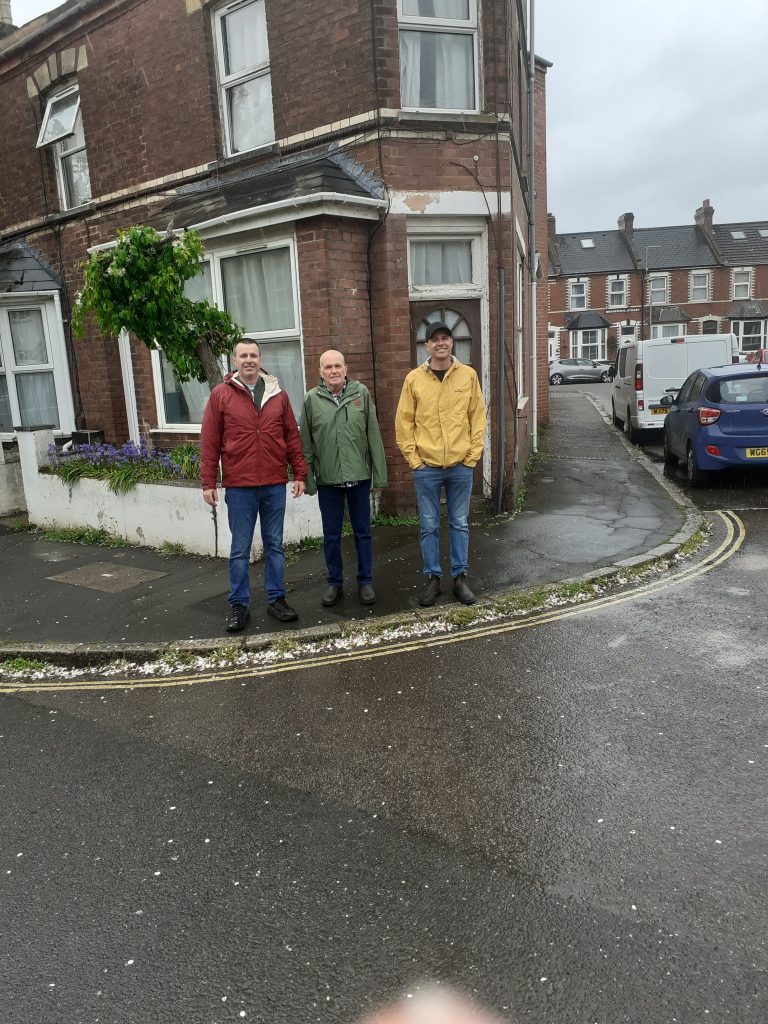
From my front window I noticed three men — two younger, one older — standing outside my house, studying it with unusual intensity. They were pointing at the front garden tiles, looking up at the bedroom window, and taking photographs of each other as if my corner of Buller Road were a landmark of great significance.
And I’ll admit it: for a fleeting moment I wondered whether they were scouting for Spielberg or Coppola and preparing to cast me as the Don of St Thomas — a sort of Devonshire Vito Corleone presiding over the corner of Buller Road. Perhaps Hollywood had come at last to pay for my firewall which is in urgent need of repair.
Many years ago, the little refrigeration business across from me was an old, quaint corner shop — the sort you rarely see anymore. One day, without warning, a full film crew descended on it. Lights, cables, cameras, people shouting instructions… the whole spectacle. I can’t even remember what they were filming — a commercial, a TV drama, something involving boiled sweets perhaps — but it was thrilling. I had never seen anything like it, and there it was, practically on my doorstep.
So when I saw those three men studying my house with such intensity today, I thought perhaps my luck had finally come round. Maybe this time it was my corner’s turn for fame, something a little grander than a soap opera cameo. Perhaps Hollywood had returned to St Thomas, and I was about to be discovered.
But the truth, as it turned out, was far more human. It wasn’t Hollywood after all, but something better. I didn’t get a location fee — I got heritage, and it was far more moving.
I watched them for a while, curious but not alarmed. Their behaviour was odd, but open, not furtive. Later, when I poked my head out again to see what they were up to, I saw they had moved on to St Thomas Park. They didn’t look like surveyors or council workers. Still, something about their focus stayed with me.
I decided I would walk over to the park to investigate further. But when I stepped outside my back door, there they were — right in front of me, as if the story had been waiting for me to join it.
And that is where the real encounter began.
The older man turned to me with a hopeful, almost fragile expression. He told me he believed this — my house — was where his mother had once lived back in the 1970s. He even gave me her name.
I had to smile. I’ve lived here nearly sixty‑four years. I don’t know every family who lived in this house before us — that history is lost to time — but I do know the families who lived around us. Clarence Road, Brunswick Street, the adjacent terraces… in the old days we practically knew everyone. He mentioned a family in Brunswick Street with five children, and I’m almost certain I knew exactly which family he meant. That was the way of things then: doors open, names known, lives overlapping.
So I gently told him he must be mistaken about my house.
He looked genuinely puzzled. Then he said, “But this is Clarence Road.”
“No,” I replied, “this is Buller Road. Clarence is the side road running alongside it.”
And in that instant, everything clicked. His face lit up with the sudden clarity that only comes when a long‑held memory finally aligns with reality. He turned, pointed across the street, and said, “That one! That’s the house!”
Of course it was. Two corner houses, both with their own odd angles and presence. Memory had simply shifted the corner by a few feet — as memory does. I could understand it completely. If my Father had ever returned to his Ukrainian village after decades away, he would almost certainly have stood outside the wrong house with absolute conviction, only to be gently corrected by some local who had never left.
The three men were from Western Australia. They had recently lost their mother, they told me, and this journey was their way of reconnecting with her beginnings. I suppose you could call it a pilgrimage — something I understand well, having travelled to see my own Mother’s home in Ukraine in 2015.
The younger son laughed and admitted he had taken hundreds of photos of his father proudly standing in front of the wrong house — my house. We all laughed together in the drizzle.
I told them that the house they were seeking had once been an Edwardian post office, and that there was a photograph of it in a local history book. Then, without hesitation, I went inside and fetched my copy and gave it to them as a gift. It felt right — a small act of kindness for travellers carrying grief, memory, and hope in equal measure.
They were touched. We took photos together — this time in front of the correct house — and then they headed off toward Exwick, where more fragments of their past awaited them.
When they return to Australia, I imagine they’ll show that book to friends and say, “There was this kind man in Exeter who put us straight.” And perhaps a little part of me — and of this street — will travel back with them to the land of 30‑degree sunshine.
It wasn’t Hollywood after all. But it was something better: a moment of human connection, a reminder of how tenacious — and how treacherous — memory can be, and how sometimes the person who has stayed rooted in one place becomes the guide for those who have travelled oceans to find their way back.
After nearly sixty‑four years on this corner, I sometimes feel like the last archivist of the old neighbourhood — the final curator of its stories, its families, its vanished rhythms. And on this rainy morning, that role mattered.
A small story, yes. But one to cherish, and one that will make me chuckle for years to come.
P.S. Although I have to admit, a location fee would still have come in very handy.