Modelling has never been just a hobby for me. It has been a thread running through my life, a way of reclaiming autonomy, of finding joy and dignity in small acts of creation. Over the years, it has become part of my identity, part of my testimony, and even part of my Father’s story. Some of my dioramas now sit alongside his memoir, as if the craft itself has become a continuation of his archive – memory preserved in plastic and paint.
The Skyhawk: Autonomy in Constraint
It began in earnest in my thirties, when I was living with my Father and later became his carer. Life then was narrow, constrained, with little autonomy. The house itself seemed frozen in time, and I was not allowed to change or renovate it. In that atmosphere, the smallest act of choice felt like rebellion.
One day, in Exeter’s Toy and Pram shop – a place of childhood Christmases and wonder – I saw the Fujimi 1/72 Skyhawk in sand and green. Money was tight, but I bought it. I had Humbrol enamels, thick as treacle, and no airbrush. The decals left water stains, the paint went on heavy. It looked nothing like the magazine models. And yet, it was mine. Unlike so much else in my life then, it was not dictated by my Father. That Skyhawk was the beginning of reclaiming autonomy, of carving out space for myself.
The Ju‑88: A Symbol at the Heart
Long before the Skyhawk, there was Bradford. I was eight or nine, travelling north on the M1 with my Father in a rented car – an old banger with a hole in the floor, through which my sister and I gleefully dropped banana peels, watching the mystified faces of drivers behind us. We had gone to visit his Ukrainian friends; there was a large Ukrainian community in the city then. For my Father, this was familiar ground – he was used to exiles and foreigners of all sorts. But for my sister and me, children of Ukrainians growing up in insular Devon in the 1960s, it was a shock. Exeter was a sleepy backwater then, where it was rare to meet non‑Europeans. Bradford felt like alien territory: soot-blackened buildings, cobbled streets, curry drifting from Asian shops and houses. We were so unprepared that we almost hid low in the back seat, wide‑eyed and uneasy at the landscape.
Perhaps the absurdity lay not in Bradford itself, but in the journey. While most families in those days streamed south‑west for their holidays, to the coasts or moors of Devon and Cornwall, we conducted our trek in the opposite direction – into the industrial north, into exile fellowship, into a world that felt back to front. Years later, I laughed when I saw Porridge, and Fletcher’s line about MacKay’s curry expertise: ‘India? No, Bradford!’ The joke captured exactly what we had felt – Bradford as bewildering, alien, and yet, in retrospect, tinged with absurdity.
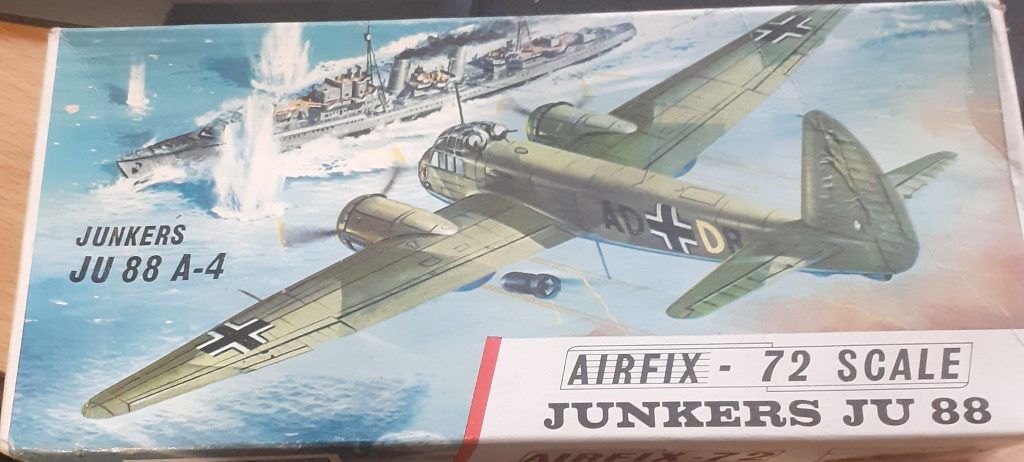
In Woolworths, my Father – in rare holiday generosity – bought me the Airfix Ju‑88 in 1/72 scale, light blue plastic, box art glowing with promise. For me, it was a jewel, a rare gift, a chance to share something with him.
But when I asked for help, he was brusque, impatient, his hands unsteady – nerves shattered by war. I returned to the instructions, sensing something was amiss. The wings had been glued on backwards! His solution was obvious to him: hack them off with a kitchen knife and glue them back on. He thrust the wounded plane back at me. I was devastated.
That ruined model embodied the contradiction: on one side, my Father – an exile brutalised by war, desperate to seize those rare moments of connection with his Ukrainian friends, still dreaming of return, unable to give the care and patience I longed for. On the other side, little Michael- full of wonder at the box art, yearning for tenderness, bewildered by brusqueness, crushed when the wings went on back to front. The Ju‑88 became the scar of that moment – a plane with back‑to‑front wings, carrying both his trauma and my heartbreak.
And yet, it was also the seed of something enduring. From that day, I vowed to treat models with care, to build with patience, to give dignity to what my Father could not. Every model I have built since carries that vow. Each careful decal, each steady brushstroke, is an act of healing – testimony that brokenness can be transformed into resilience.
Interlude: The Jagd Tiger
It was Christmas in Exeter, in the magical Toy and Pram shop. I was overwhelmed by the shelves of model kits, and on the top sat the Tamiya 1/35 Jagd Tiger, its box art filling my child’s eyes with wonder. I wanted it desperately, though I knew it must be too expensive. To my astonishment, my Father bought it for me.
I tried to build it, and managed the assembly, but the painting stage brought heartbreak. I had no knowledge of German camouflage colours, and when the instructions said dark brown and dark yellow, I reached for the only enamel paints I had. The result was a diseased patchwork of bright brick red over lemon yellow splotches. I could not ask my Father for help; he would not have understood. So the Jagd Tiger was abandoned in a dark corner of shame of my wardrobe, a permanent reminder of what could have been.
A few years ago at a model show, I bought that same Airfix Ju‑88 from Bradford days. It seemed so small now, but I keep it in my stash, unsure whether to build it or simply preserve it as memory.
Modelling as Testimony
From those beginnings – the ruined Ju‑88, the diseased Jagd Tiger, the imperfect Skyhawk – grew a craft that has sustained me through caregiving, through work, through Covid, and into today. Over time I learned varnishing, decals, airbrushing. Now I can build to a high standard. But the meaning has never been in perfection. It has always been in the act: the ritual of climbing the stairs to my modelling room, the sanctuary of that space, the testimony of resilience.
Modelling became part of me, part of my life, and even part of my Father’s memoir. Some of my dioramas now sit alongside his story, as if the models themselves are witnesses – fragments of memory, crafted with care, carrying forward the dignity of both our lives. His words preserve the past; my models preserve the witness of living through it. Together, they form a dialogue across generations: memory and craft, archive and testimony, Father and son.
And yet, my care and meticulousness did not come from him. They came from my Mother, a Ukrainian Hutsulka, whose embroidery was intricate and wondrous. From her I inherited the attention to tiny details, the patience to dignify small things. Where my Father’s hands were shattered by war, hers created beauty stitch by stitch. In my modelling, I carry both legacies: his brokenness and exile, her artistry and care.
So each model I build is more than plastic and paint. It is a dialogue between them, and within me: a Father’s memoir of survival, a Mother’s embroidery of beauty, and my own testimony of resilience.