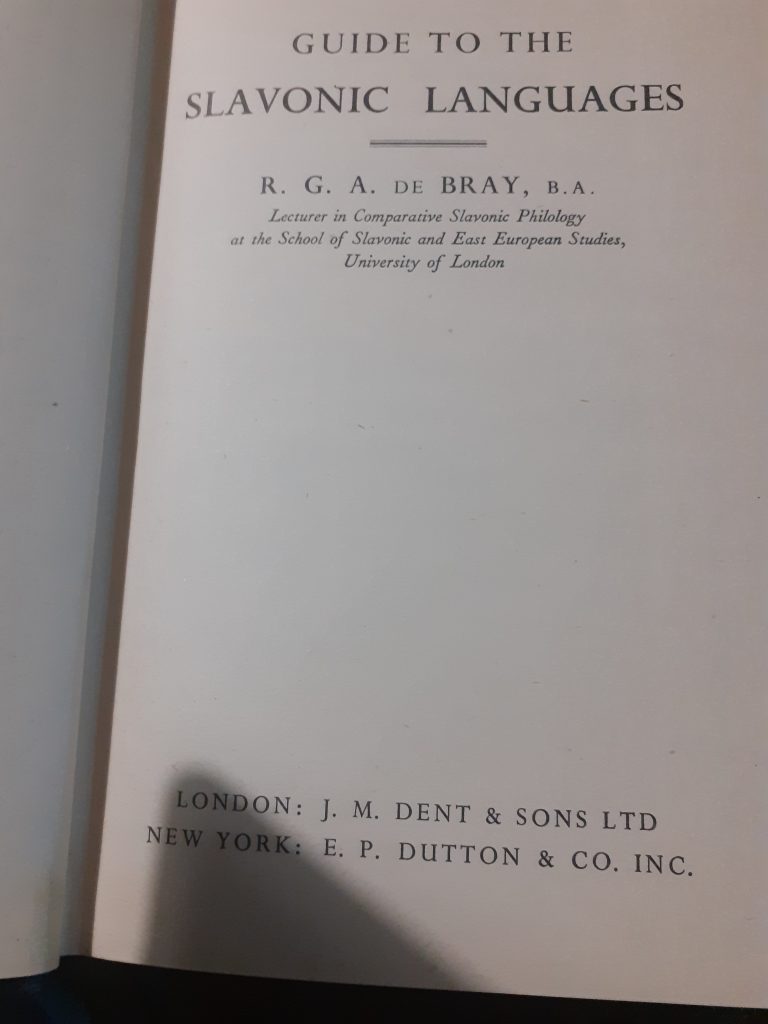
I recently came across a remarkable find: Guide to the Slavonic Languages by R.G.A. DE Bray, a lecturer at the institution I once studied at, though long before my time. Even for someone like myself, who is not a scholar of Slavonic languages, it is a treasure trove. The book resonates on many levels: it speaks of a gentler, more refined era, when scholarship was exacting and the pursuit of knowledge meticulous.
It is a mammoth work, which gives a summary of every language of the Slavonic group: Old Slavonic (Old Bulgarian), Russian, Ukrainian, Byelorussian, Bulgarian, Macedonian, Serbo-Croatian, Slovenian, Czech, Slovak, Polish, Lusatian (or Wendish).
The Hidden Heroine
In his Preface, DE Bray writes: “It gives me pleasure also specially to mention the tireless help, encouragement and expert criticism of my wife, who also performed the stupendous feat of typing the entire work in preparation for printing. her knowledge of several Slavonic languages and her understanding and sympathy with the aims of my work enabled her to make valuable suggestions in shaping the book.
I would also like to thank my publishers, Messrs. J.M. Dent and Sons, Ltd., for their endless patience and unfailing encouragement in the writing of this work over a period of seven years and under various difficult circumstances.”
DE Bray’s indefatigable wife really does emerge as the unsung heroine here. Just imagine the ordeal: seven years of typing the entire manuscript, a task that must have been Herculean given the diacritics and unfamiliar alphabets of Slavonic languages – all on a manual typewriter, with no digital shortcuts. Her “stupendous feat” wasn’t just clerical; her own knowledge of Slavonic languages meant she was actively shaping the book, catching errors, and offering suggestions.
One imagines her at the typewriter, clacking away under blackout curtains, doodlebugs flying, the outside world collapsing, determined that the manuscript should be finished.
It’s a reminder that scholarship is often a partnership, yet he never even mentions her by name-a silence that makes her contribution all the more invisible.
And then that closing line – thanking the publishers for their “endless patience and unfailing encouragement… over seven years and under various difficult circumstances.” It is classic British understatement. “Difficult circumstances” likely meant wartime disruption, rationing, perhaps even bombs falling nearby. Yet the manuscript had to be finished. Scholarship as endurance, almost defiance: the book must go on, even in the shadow of war.
It is easy to see why I feel a kinship with DE Bray. That mixture of meticulous devotion, quiet humour, and sheer stubbornness, or perversity, in the face of adversity is very much in tune with my own witness.
I didn’t have a hidden heroine; I have my digital helpers, a blinking cursor in Word, now joined by AI to help refine and carry forward my great archive. And my nephew too, of course. Different eras, different tools, but the same devotion to finishing testimony – whether under bombardment or beneath the quiet glow of a screen.
However, DE Bray sets out to give the student not merely technical knowledge of languages, but a pathway into understanding the cultures, literatures, and histories that they embody. His work reminds us that language is inseparable from the worldview it carries, and that careful, attentive study opens a window into the lives, values, and sensibilities of others.
Finding this book, unexpectedly, among the shelves of Oxfam, was a reminder that the past still offers treasures, and that these treasures can illuminate both history and our contemporary understanding of the world.
DE Bray writes:
The ultimate aim of this work is to enable a direct and reliable approach to be made to the wider issues reflected in the Slavonic literatures and their background, through an accurate knowledge of the Slavonic languages, and so help to create true understanding and friendship between the Slav peoples, great and small, and the English-speaking world. The student is urged always to have those ‘wider issues’ in view and to remember that even an accurate translation, if it is torn from its context and background, can be totally misleading and distort the truth. To know the reality, truth and beauty of the Slavonic world is an unforgettable experience. It enriches and brings hope. (xxiv).
Reading these words now is poignant and sorrowful. The conflict between Ukraine and Russia reminds us how fragile such understanding can be, and how easily shared history and culture can be shattered. DE Bray’s admonition about context and the deeper issues behind language is a lesson not just for translators or linguists, but for anyone seeking to comprehend the unfolding human tragedies around us. In a world where superficial familiarity is often mistaken for true understanding, his ideal – that knowledge of language can bridge peoples – is both more urgent and more elusive than ever.
DE Bray closes his discussion with a short epigraph in Ancient Greek, which I believe means something like: ‘Behold it, as you hope for much, and rightly so’.
For most modern readers, the letters are opaque, but the sentiment is immediate and uplifting. In context, DE Bray is urging the student to approach the Slavonic world with care, attention, and hope: to see its richness in full, to respect its complexity, and to seek understanding that is faithful to its context. It is a call to notice, to engage, and to value what is genuinely there, rather than what might superficially appear.
This epigraph resonates deeply with my reflections on language, culture, and the current conflict in Ukraine. DE Bray reminds us that knowing a language is not just about words or grammar; it is about accessing the worldview embedded in that language – the history, values, and assumptions that shape thought and action. Superficial familiarity is not enough: one must “behold” the reality fully, in its texture and depth, if one hopes to understand it.
In the Soviet Union and post-Soviet Russia, I saw a world shaped by material obsession and dehumanisation, whose meanings are not always legible to outsiders. Misreading those signals, or assuming that imported forms automatically carry the underlying values, is much like the “cargo cults” a Ukrainian friend described: appearances of Westernization without the cultural infrastructure to sustain them. DE Bray’s epigraph becomes a guiding principle: see fully, with context, and hope rightly. Only by doing so can one appreciate the true stakes in Ukraine, and the urgent need for understanding, engagement, and moral clarity.
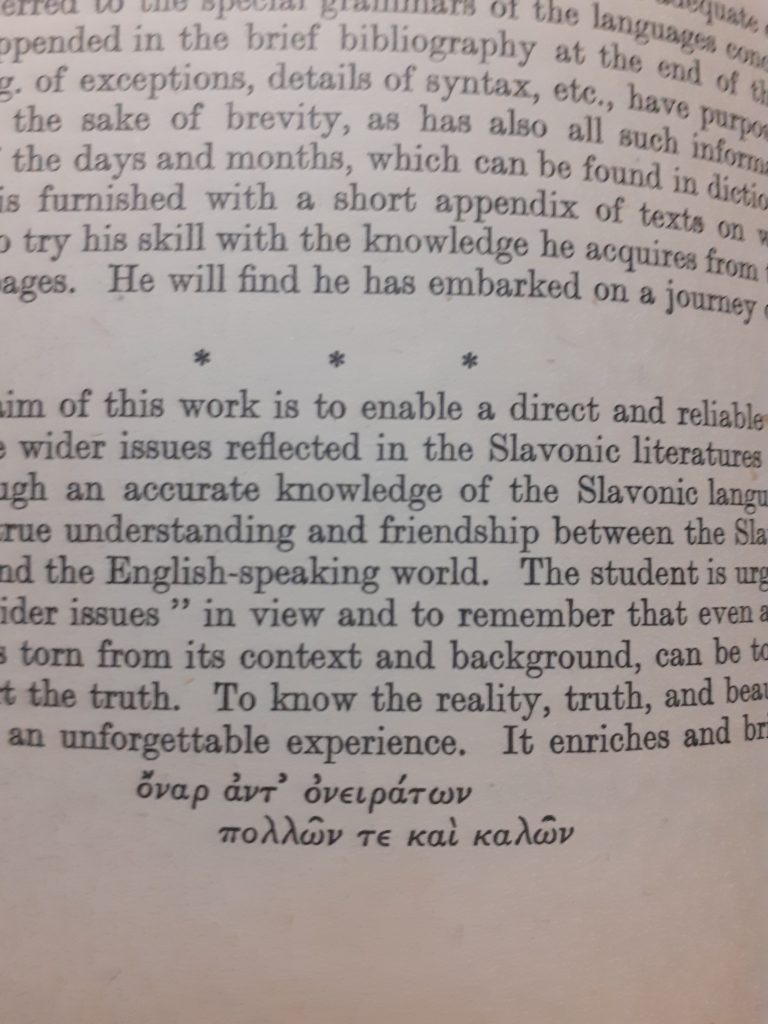
Epigraph: A Call to See
From R.G.A. DE Bray, Guide to the Slavonic Languages
Translation: “Behold it, as you hope for much, and rightly so.”
This lesson is urgent in the context of Ukraine. Language, culture, and history shape how societies act and understand the world. Superficial familiarity or mimicry, like the “cargo cults” analogy, can mislead. De Bray’s epigraph is a call: see fully, respect context, and hope rightly – principles that guide how we must engage with Ukraine today.
Historically, the Ukrainian language faced repeated suppression. As DE Bray notes, even in the 18th and 19th centuries, Ukrainian was “still not generally recognized as a separate language”. Even the Czech scholar Josef Dobrovsky, the founder of modern Slavonic studies, refused to recognise Ukrainian as anything more than a dialect of Russian – a perspective that would have pleased modern Russian ethnonationalists. Under the Tsars, the language was actively constrained: in 1863 it was forbidden as a language of instruction in schools, and in 1876 the printing and publishing of proper Ukrainian was banned. Only texts printed in Russian orthography were allowed, mockingly nicknamed yarizzhka, the “messenger boy’s spelling.” It was not until 1905, with a new constitution, that these restrictions were lifted and Kyiv regained its place as the cultural centre of Ukraine.
This history underlines that the current conflict is not simply geopolitical or military; it is also a struggle over identity, language, and the right of a people to define themselves culturally and politically. For centuries, Ukrainian linguistic and cultural expression has been constrained by external power, and the echoes of those policies still resonate in the ideologies driving Russia today.
DE Bray also draws attention to the extraordinary resilience of the Ukrainian people during the Second World War:
“In the recent war, Ukraine suffered and was devastated as terribly as any land in Europe and her people were stirred to superhuman efforts. These will doubtless leave their traces in subsequent Ukrainian literature and in the development of the language. The student can be encouraged to explore the new literature and keep his mind sympathetic and open.”
The irony is bitter today: in Putin’s rhetoric, Ukrainians are dismissed as “Nazis,” their heroism erased, their sacrifices denied – a cruel inversion of the reality that De Bray so respectfully recorded. The same people who endured unimaginable suffering and contributed immeasurably to the defeat of Nazism are now subject to narratives that seek to delegitimize their history and identity.
In my own time in Kyiv in 1981–82, Ukrainian was rarely heard in the capital; it was largely confined to homes or more rural areas. Yet despite decades of political and cultural pressures, the language endured, quietly awaiting conditions in which it could flourish once more.
Language, Empathy, and Endurance
For contemporary readers, De Bray’s work offers more than linguistic insight. It is a meditation on empathy, on the patience required to see and appreciate another culture on its own terms. It reminds us that languages carry with them histories, values, and experiences that cannot be reduced to mere words. In the case of Ukraine, his reflections illuminate both the fragility and the resilience of a language and people who have endured centuries of suppression, yet whose identity and culture persist.
In a world too often shaped by superficial understanding, quick judgments, and narratives that erase complexity, DE Bray’s scholarship offers a model: careful observation, contextual awareness, and the hope – rightly placed – that attentive study can foster genuine comprehension and friendship across cultures. His book is a treasure not only for students of Slavonic languages, but for anyone seeking to understand the enduring human and cultural threads that connect past and present, and that make witnessing, recording, and appreciating another people’s experience an ethical imperative.
It is all the more remarkable when one considers the context in which DE Bray was working. Most of the Slavonic-speaking world was, at the time, behind the Iron Curtain, with travel and access restricted, information tightly controlled, and scholarly exchange severely limited. Even in my own time, decades later, hearing Russian spoken outside small communities of exiles in the UK was extremely rare.
To devote oneself so fully to these languages, to master such a diversity of forms, and to continue this work through the upheavals of the Second World War, is simply breathtaking. DE Bray was a scholar of the first order: rigorous, passionate, and extraordinarily committed to the pursuit of understanding across linguistic, cultural, and historical boundaries. His work reminds us that true scholarship is not merely technical proficiency, but also patience, courage, and a deep respect for the human worlds those languages express.
I have met scholars of a similar calibre at the institution where I studied, and it is profoundly humbling. You arrive at eighteen thinking you know quite a bit, only to find yourself in the presence of people whose depth of knowledge, precision, and intellectual dedication makes your own learning feel miniscule by comparison. Not all of them, however, were as humanistic, sympathetic, or warm as DE Bray appears to have been. Dedication to a subject can sometimes come at the expense of empathy or feeling, and I witnessed scholars who seemed almost removed from humanity, brilliant yet austere.
The extraordinary balance – total commitment to a field while keeping the human always in view – is rare, and DE Bray seems to embody it. For me, this is why, at the end of the day, I would always return to my Father. He restored my belief and filled me with warmth, compassion, and humanity – the same qualities that scholarship, at its best, ought to nurture. This is part of what language, and the study of it, should ultimately be about: connecting minds and hearts, and keeping the human in focus amidst the rigour of learning.
Sign-Off: Continuity and Reflection
This entry sits alongside my reflections on my Father’s memoir and my observations of Ukraine today. While the political and historical realities of conflict demand urgent attention, the patient work of understanding language and culture reminds us that human experience is layered, enduring, and often paradoxical. DE Bray’s scholarship invites us to slow down, to see the world through different lenses, and to recognize the resilience of those whose voices might otherwise be suppressed. It is a reminder that witnessing and recording – whether through memoir, essay, or careful study – is itself a form of engagement, a bridge between the past and the present, and a way to honour the richness and dignity of human life.
On Russian and the Profanum Vulgus Professor Jopson, quoted by DE Bray, reminds us that Russian belongs among the “fairest company” of world languages, though the profanum vulgus – those uninitiated in Cyrillic – cannot be expected to feel its greatness. Yet even the outsider, hearing Russian spoken for the first time, may be struck by its melody. The divide between scholar and layman is real, but not impermeable.
And perhaps, with a smile, I should admit that most of us – my friends and family included – belong to the profanum vulgus. It is no insult, but a reminder that beauty in language can reach us even when we stand outside the temple of scholarship.
The Roman poet Horace famously wrote “odi profanum vulgus et arceo” – “I hate the unholy rabble and keep them away.”
DE Bray’s whole project was to show that every Slavonic language – Ukrainian, Belarusian, Czech, Polish, Lusatian – deserved careful study, not just Russian. By including Jopson’s classical phrase in the Russian chapter, he acknowledges the elitist tradition of philology, but he also gently resists it by giving equal dignity to the “lesser” tongues.
Here is Jopson waxing in full classical register: “Whether it is the wealth of the Russian vocabulary that attention is focused on, or the nobility of expression and the harmony of the language, it is generally recognized that Russian can hold its own in the fairest company. Those who belong to the profanum vulgus, to whom the Cyrillic alphabet, however attractive to the eye, is a mystery, cannot of course be expected to feel the greatness of the language. It is nevertheless a matter of common experience that a person completely ignorant of Russian, who for the first time hears the language spoken by a native, will involuntarily exclaim: ‘Why, how melodious Russian sounds – I always thought it was so hard, nothing else but a succession of long syllables, of unpronounceable words’. Nothing is falser than so unflattering a judgement, for once a learner has sufficiently overcome the difficulties of the language to be able to understand it when spoken, and to appreciate, dimly perhaps, but still appreciate, the written word of the great writers, his admiration increases till he is unrestrainedly ready to subscribe to the touching and famous words of one of Russia’s noblest writers”.
Then he quotes Turgenev: “in days of doubt , in days of painful reflection on the fate of my country, you alone give succour and support to me, o great, mighty truthful and free Russian tongue. Were it not for you, how should one not fall into despair when seeing all that is taking place at home? But it is impossible to believe that such a language was not given to a great people”.
“В дни сомнений, в дни тяжёлых раздумий о судьбе моей родины,
ты один мне поддержка и опора, о великий, могучий, правдивый и свободный русский язык!
Не будь тебя – как не впасть в отчаяние при виде всего, что совершается дома?
Но невозможно верить, чтобы такой язык не был дан великому народу.”
Turgenev’s words carry a cadence and music that English translation can’t quite capture. Russian has those long vowels and flowing consonant clusters that make even solemn lines sound lyrical.
For example, the opening phrase “В дни сомнений, в дни тяжёлых раздумий о судьбе моей родины…” has a rhythm that rises and falls almost like a chant. Even without full understanding, the sound conveys gravity and tenderness. That’s why Jopson was so insistent that Russian’s “melodiousness” could be felt even by outsiders – the ear catches something the eye (struggling with Cyrillic) might miss.
V dni somneniy, v dni tyazhyolykh razdumiy o sud’be moey rodiny,
ty odin mne podderzhka i opora, o velikiy, moguchiy, pravdivyy i svobodnyy russkiy yazyk!
Ne bud’ tebya — kak ne vpast’ v otchayanie pri vide vsego, chto sovershayetsya doma?
No nevozmozhno verit’, chtoby takoy yazyk ne byl dan velikomu narodu.
The repeated v dni…v dni, gives it a solemn, almost incantatory rhythm. The rising and falling candence sounds almost like a liturgical chant, especially the sequence pravdivyi i svobodnyy russkiy yazyk.
Jopson’s passage is both amusing and revealing: it shows the old philological habit of drawing a sharp distinction between the ‘initiated’ and the ‘rabble’, while at the same time admitting that language’s beauty can spill over those boundaries.
To us today, Jopson’s rhetoric feels almost comical in its certainty and grandeur, but it reflects the scholarly ethos of the time. Languages were not just studied, they were revered as moral and aesthetic worlds.