1. Oxfam Discovery: A Tangible Connection to the Soviet Past
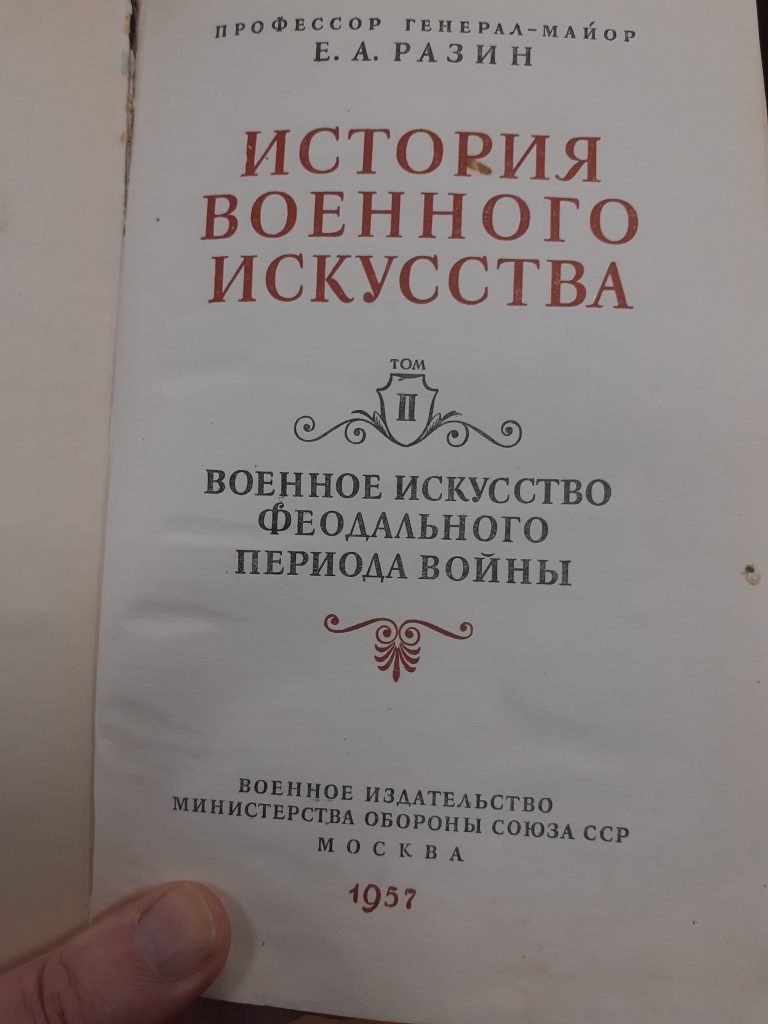
It was in Exeter’s Oxfam second-hand bookshop – almost my second home – that I recently stumbled upon a worn copy of The History of the Military Art by E.A. Razin, Volume II – part of the three-volume Soviet classic printed in 1957 (Istoriya Voennogo Iskusstva, Voennoe Izdatel’stvo Ministerstva Oborony Soyuza SSR, 1957). The cloth binding was a little tatty, its pages slightly loose and faintly musty, and inside was even a wafer-thin receipt stamped with a price in roubles! I wondered what odyssey this book must have taken to find its way to Exeter in 2025 – perhaps from the library of a Soviet officer of the Stavka, the Soviet General Staff. For a moment I hesitated, tempted to buy it despite the exorbitant price, drawn less by the text itself than by the object – a relic of a vanished world. To hold it was to feel once again the strange allure that the Soviet Union held for me in my youth: the austere scholarship of its military theorists, the dog-eared volumes of Marx and Clausewitz that once lined the shelves of London’s Russian bookshops, the hope that ideas could explain the cataclysms of history.
2. Geography, Nomads, and Strategic Context
The strategic environment of Russia has long shaped its history and military thought. Located on the vast northern Eurasian plain, with few natural boundaries to defend, the country has always faced the necessity of projecting military power across enormous distances. This geography has conditioned both its generals and its historians: security concerns often dominate, sometimes to the detriment of peaceful civilian development.
As Razin shows in meticulous detail, the succession of nomadic invasions – above all by the Mongols – repeatedly challenged Russian principalities. Yet there is a notable tension in his framework: the Asiatic steppe armies, lacking a settled economic base, succeeded through mobility, discipline, and highly efficient organization. They could achieve devastating operational effects, but ultimately could not establish the deep, sustainable military systems that a developed economic base permits. Razin’s method, emphasizing material conditions as the primary determinant of military outcomes, must therefore interpret such exceptional forces as strategically limited phenomena.¹
3. The Militarized Soviet State
The strategic and social environment of the Soviet Union itself illustrates Razin’s insight in practice. Unlike premodern states, the USSR was a militarized society, geared explicitly for the possibility of total war. Stalin’s five-year plans were not only exercises in economic planning but in strategic preparation: heavy industry, transportation networks, and the urban workforce were all developed primarily to support defense needs. In effect, the Soviet state was building a material base that had not yet existed, in order to produce an armed force capable of defending it — a kind of self-justifying loop in which industrialization, military doctrine, and strategic necessity reinforced one another. Razin’s analysis of historical armies as products of their productive base thus acquires an immediate, almost prophetic resonance in the context of the USSR: theory and praxis converged in a single, massive effort to create both the means and the instruments of modern warfare.²
4. Razin and the Marxist-Dialectical Framework
Razin’s History of the Military Art was conceived as a vast synthesis — a Marxist interpretation of warfare from antiquity to the Second World War. Written in the high Stalinist idiom of “scientific socialism,” it opens with the requisite citations from Marx, Engels, and Lenin, yet these were not mere formulae. They formed the scaffolding of Razin’s method. For him, the art of war evolved in accordance with the productive base of society: its economy, its technology, its social relations of class and labour. The rise and fall of military systems mirrored the dialectic of historical development itself.³
Razin’s framework extended Lenin’s revision of Clausewitz’s dictum that “war is the continuation of politics by other means.” Clausewitz had written as a soldier of the early bourgeois age, for whom war was an instrument of state policy; Lenin redefined it as the continuation of the class struggle by violent means. Razin, following this line, saw war not as an autonomous art but as a social process, the violent expression of contradictions already latent in the economic structure of its time.
From this standpoint, he drew a sharp distinction between “progressive” and “reactionary” wars. The English Civil War, he wrote, was progressive because it overthrew feudal absolutism and cleared the path for capitalism; the Crusades, by contrast, were reactionary, entrenching the feudal order under the guise of faith. History, in Razin’s telling, moved not through the genius of great commanders but through the collision of material forces. “Alexander, Caesar, and Napoleon,” he observed, “could not have achieved what they did had not the objective conditions of their age made it possible.” Victory, in the end, depended on objective conditions, not on the accidents of leadership.⁴
5. Interwar Soviet Thinkers and Glubokaya Operatsiya
Razin’s intellectual debt to his interwar predecessors was profound. In the 1920s and 1930s, Soviet theorists such as Aleksandr Svechin, Vladimir Triandafillov, and Mikhail Tukhachevsky had attempted to translate Marxist dialectics into operational theory. Svechin defined strategy as an art that must remain fluid, dialectical — never a dogma.⁵ Triandafillov, in his seminal The Nature of the Operations of Modern Armies (1929), advanced the concept of glubokaya operatsiya, the deep operation: a vision of modern war fought not by divisions but by entire productive systems — logistics, industry, and manpower fused into a continuous mechanism of depth and scale.⁶ Tukhachevsky, the “Red Napoleon,” sought to realize that vision through mechanization and mobility before his execution in Stalin’s purge of 1937, a tragedy that silenced much of the early Soviet strategic avant-garde.⁷
Razin’s History, published in the more cautious post-Stalin years, can be read as a veiled rehabilitation of those lost thinkers. Beneath its orthodox surface, it carries forward their essential insight: that the character of war flows from the material and technical base of society. The early disasters of the Great Patriotic War — the immense losses of 1941–42 — only confirmed this. The Soviet Union prevailed not through tactical brilliance but through its capacity to reconstitute its productive base, to shift entire industries beyond the Urals, to mobilize its population and reforge its armies on an industrial scale.
My Father, though he would never have read Razin, intuited something of this truth from his own experience:
“No amount of courage or tactical proficiency could overcome the true engines of modern warfare: numbers, machines, supply lines, and above all, air power. The Wehrmacht and Waffen-SS may have been better soldiers man for man, but they were ultimately crushed not by inferior fighters, but by industrial scale, by logistics, and by the overwhelming firepower of the Allied and Soviet juggernauts.”
6. Divergence from Western Military Thought and Readability
Where Razin and the Soviet dialectical tradition diverged most sharply from Western thought was in their philosophy of causation. The Western theorists of the early twentieth century — J.F.C. Fuller, B.H. Liddell Hart, and their continental predecessors such as Antoine-Henri Jomini — treated war as the domain of timeless principles, a science of manoeuvre, willpower, and generalship. Fuller’s The Foundations of the Science of War (1926) and Liddell Hart’s Strategy: The Indirect Approach (1941) prized the autonomy of the commander’s intellect and the moral economy of force. Their theories, though rational and elegant, were ultimately voluntarist: they presupposed that strategic success derived from the enlightened will of the few.
Razin and his Soviet contemporaries rejected this voluntarism outright. For them, there were no universal principles, only historically conditioned laws rooted in the evolving means of production. Military genius could not transcend the epochal limits of the material base; even strategy itself was an expression of the social relations from which it sprang.
What makes Razin’s work especially compelling – and for me personally so enjoyable – is the way it combines clarity, narrative sweep, and scholarly depth. Unlike many Western academic texts, which often become dense, highly technical, or narrowly specialized, Razin’s prose remains readable and integrated. The maps, operational diagrams, and illustrations throughout the volumes are not mere embellishments; they are essential analytical tools, allowing the reader to visualize campaigns, manoeuvres, and operational depth. The maps, especially, give a sense of scale and geography, bringing to life the strategic challenges faced by Russian armies across the centuries.
In this respect, Razin achieves something rare: a work that is simultaneously scholarly, comprehensive, and accessible, bridging the gap between theory and practice, between historical narrative and operational insight. It is a text that rewards careful reading, yet never alienates the reader with unnecessary technicality – a quality that helps explain why it remains a classic in Russian military historiography.
7. Engels, “Marx’s General”
Razin draws extensively on Engels to illustrate the historical development of military organization. Engels, often called “Marx’s General,” wrote in 1855:
“The Roman army … represents the most perfect system of infantry tactics invented during an era that did not know the use of gunpowder. It preserves the preponderance of heavily armed infantry in compact formations, but adds to it: the mobility of individual small units, the ability to fight on uneven ground, the arrangement of several lines one after the other, partly for support and partly as a strong reserve, and finally a system of training for each individual warrior, even more expedient than that of the Spartan. Thanks to this, the Romans defeated any armed force that opposed them, both the Macedonian phalanx and the Numidian cavalry.”
This quotation demonstrates Engels’ deep understanding of military history and organization. His analysis underscores the dialectical relationship between social structures, technology, and military effectiveness, a perspective that Razin adopts throughout his work.
Footnote:
Friedrich Engels (1820–1895), often called “Marx’s General,” combined rigorous historical scholarship with practical understanding of military affairs. He analysed armies from antiquity to the modern era, emphasizing the interaction between social structures, economic capacity, and military effectiveness. Engels’ works, including The Armies of Europe (1855), demonstrate his expertise in organization, tactics, and logistics. His analyses informed Marx and provided a framework for understanding war as a socially and economically conditioned phenomenon – an approach that directly influenced Soviet military theorists such as E.A. Razin.
8. The Liberation War of the Ukrainian People (Zaporozhian Cossacks)
Ironically, as I glanced through Volume II, I stumbled upon the section titled “The Liberation War of the Ukrainian People and Its First Period”. This part of Razin’s work deals with the Zaporozhian Cossacks, examining their social organization, military methods, and role in the broader struggle against feudal and imperial oppression.
Razin treats the Cossack campaigns not merely as tactical episodes, but as expressions of popular social forces. He emphasizes how the objective conditions of the time – the economic base, class contradictions, and regional geopolitics – shaped their successes and limitations. The analysis fits neatly within his Marxist framework: military action is a reflection of social struggle, and the ability of the Cossacks to mobilize forces depended on more than charismatic leadership; it depended on the material and social realities of their environment.
For the contemporary reader, the discussion feels strikingly relevant. In 2025, as Ukraine faces new existential challenges, there is a certain historical echo in Razin’s account: war as a continuation of social and national struggle, with military outcomes shaped not only by individual skill or heroism, but by the capacity of communities to organize, sustain themselves, and harness the resources at their disposal. The section is meticulously detailed, with maps, tables, and illustrations that convey both the geography of the campaigns and the scale of the forces involved – elements that make the narrative vividly tangible.
In this sense, Razin’s work is not only a historical account, but also a lens for understanding the enduring interplay of social forces, military organization, and strategic environment, which continues to resonate in the modern context of Ukraine.
9. Cannae, Schlieffen, and the Development of the Art of War
Razin’s analysis of the Battle of Cannae provides a striking illustration of his Marxist-dialectical approach to military history. German theorists of the early twentieth century – particularly Alfred von Schlieffen – canonized Cannae as a “model” for modern warfare, arguing that Hannibal’s tactical envelopment could serve as a blueprint even for contemporary armies. Schlieffen wrote:
“For 2000 years, weapons and methods of warfare have completely changed… But in general terms, the combat conditions remained unchanged. A battle of annihilation can be fought even now according to Hannibal’s plan, drawn up in time immemorial.”
Razin exposes the absurdity of this claim. The scale, technology, and social context of modern armies make a direct repetition of Cannae impossible. Tactical genius alone cannot overcome the material and social conditions of the age. Moreover, Schlieffen misattributes victory to Varro’s incompetence rather than Hannibal’s skill, and inconsistently emphasizes force superiority while simultaneously admiring the Carthaginian outflanking – a contradiction rooted in a voluntarist, enemy-centred perspective.
From Razin’s perspective, the error is clear: war is historically conditioned. Military tactics and operational art evolve with society’s productive forces, technological capabilities, and organizational sophistication. Tactical encirclement in 216 BCE differs in scale, means, and operational context from Sedan (1870) or Stalingrad (1942–43). Cannae is tactical, Sedan operational, Stalingrad strategic – each reflecting the development of warfare alongside societal and economic evolution.
Razin’s critique also illuminates a broader point often overlooked in Western historiography: the Germans’ obsession with Cannae-like encirclements in both World Wars ignored critical material realities. By 1939, Germany’s economic base was too narrow to sustain the grand ambitions of its military planners. Resource shortages, insufficient industrial capacity, and overstretched logistics created inconsistencies and contradictions in strategy. Ideological assumptions – whether notions of racial superiority or the brilliance of German military genius – could not overcome these material limits. In the end, the sheer overwhelming might of their adversaries, particularly after the entry of the United States with its virtually unlimited resources, proved decisive.
Thus, Razin’s lesson is not merely historiographical. It underscores a central principle of his military theory: strategic outcomes depend on the objective material and social conditions, not solely on the genius or will of commanders. The German fascination with Cannae serves as a cautionary tale: historical analogies, if applied without regard to context, can mislead and even endanger armies. Conversely, the Soviet successes at Stalingrad demonstrate how modern industrialized warfare, backed by a robust social and economic base, enables operational and strategic mastery at unprecedented scale.
In short, Razin reminds us that the art of war develops dialectically, from simpler to more complex forms, in tandem with the evolution of society, production, and technology. Tactical brilliance is valuable only insofar as it aligns with material reality, a principle as relevant to historical analysis as it is to contemporary strategic thought.
10. Postwar Doctrine and Contemporary Relevance
After 1945, Razin’s dialectic of war found new expression in Marshal Vasilii Sokolovsky’s Military Strategy (1962), which integrated nuclear weapons into the Marxist conception of the “material–technical base.” From there the lineage continued: Ogarkov in the 1970s, emphasizing the “scientific–technical revolution”; Slipchenko in the 1990s, theorizing “sixth-generation” and non-contact warfare; and finally Chekinov, Bogdanov, and Gerasimov in the new century, who reinterpreted the same dialectic under the conditions of hybrid conflict. In each case, the Marxist scaffolding faded, but the materialist instinct endured — the conviction that war, whatever its outward forms, remains a function of the economic and technological substratum of society.
Yet today that substratum is shifting beneath our feet. The categories of Marxist military theory – base and superstructure, productive forces, class content – feel increasingly inadequate to the new terrain of grey-zone conflict, digital manipulation, and information warfare. In the so-called “Gerasimov doctrine,” the boundary between war and peace has dissolved into a spectrum of political, informational, and technological contestation that rarely erupts into open battle. The war in Ukraine has revealed both the persistence and the limits of the old dialectic: industrial scale still decides outcomes, yet digital systems, drones, and data now constitute the new logistics of war.
Beyond that horizon lies something still less tangible. The emergence of artificial intelligence, with its vast appetite for energy and data, threatens to transform not only warfare but the very structure of human labour and knowledge. The productive base itself – once the Marxist foundation of history – is becoming increasingly autonomous, less human. Perhaps in that sense Razin’s dialectic still applies: the means of production, having shaped every previous form of conflict, now reshape the battlefield of the mind.
To handle his book again – the faded paper, the Soviet typeface, the ghost of roubles past – was to touch the afterimage of an age that believed in the intelligibility of history. Whether that faith still holds is another matter. But Razin’s central insight endures: that war, whatever else it may be, remains the mirror of its time – the final, violent expression of what a society has become.
Notes
· Razin, Istoriya Voennogo Iskusstva, Vol. II (Moscow: Voenizdat, 1957).
· Ibid.; also Engels, Anti-Dühring (1878); Lenin, Socialism and War (1917).
· Ibid., Vol. I, introduction.
· Ibid., Vol. I, introduction.
· A.A. Svechin, Strategiya (Moscow: Voenizdat, 1927; English trans., Minneapolis: East View, 1992).
· V.K. Triandafillov, Kharakter operatsiy sovremennykh armiy (Moscow: Voenizdat, 1929).
· Reese, R.R., The Soviet Military Experience: A History of the Soviet Army, 1917–1991 (London: Routledge, 2000), pp. 54–58.
· J.F.C. Fuller, The Foundations of the Science of War (London: Hutchinson, 1926); B.H. Liddell Hart, Strategy: The Indirect Approach (London: Faber and Faber, 1941).
· Sokolovsky, V.D., Military Strategy (Moscow: Voenizdat, 1962); Chekinov, S.G., Bogdanov, S.A., The Nature and Content of Modern Military Conflicts (Moscow: Voyenizdat, 2013).
📚 Availability on Militera.lib.ru
- Main page: Разин Е. А. История военного искусства (3 volumes) is hosted in a Russian online library section “Военная литература / Военная мысль.” (militera.lib.ru)
- The site gives a “.rar single file” download option, combining volumes. (militera.lib.ru)
- There is also a dedicated illustrations (“ill.”) directory preserving maps, plates and visual material. (militera.lib.ru)
- Volume II (VI–XVI веков): fully accessible. You can read book-length HTML format of Razin’s second volume. (militera.lib.ru)
- The volume includes title, preface, introduction, chapters etc. (militera.lib.ru)
- Volume III (XVI–XVII вв.): also available in HTML form. (militera.lib.ru)
- This includes preface, content and the chapters in the period of early modern warfare. (militera.lib.ru)
- Volume I: The main listing suggests Volume I is also present (it is part of the 3‑volume set). The site’s main page cites the three volumes, including Volume I (earlier periods) in the 3‑volume edition. (militera.lib.ru)
- The preface and introductory passages for Volume I are accessible. (militera.lib.ru)
- Maps and illustrations: the “ill.” section is preserved separately. You can access the plates, maps, diagrams etc. through that directory. (militera.lib.ru)
- Edition: The online text is based on the Polygon edition, 1999 (which is a later reprint) but draws from the original Voenizdat 1955 version. (militera.lib.ru)