A report has just been issued claiming that Exeter is now among the worst places in Britain for traffic congestion. As someone who spent many years driving professionally through every corner of this city, I feel obliged to offer my own perspective — not just as a former taxi driver who has watched the roads clog and the bridges strain, but as a long‑time resident who has seen Exeter change from a quiet, almost sleepy place into the gridlocked city it has become. What follows begins with the practical realities I’ve witnessed behind the wheel, but it ends, inevitably, in a more philosophical coda about progress, memory, and the world we have built around ourselves.
People often say, “Ah, but have you been to Oxford, or Reading, or Bristol?” as if the misery of other cities somehow makes Exeter’s congestion easier to live with. I’m sure those places are dreadful too — but I don’t live there. I live here, and Exeter’s problems are Exeter’s problems, and they affect daily life in ways that comparisons never soften.
I’ve driven these roads for decades, including many years as a taxi driver, and I’ve watched the city change from what we jokingly called Trumpton or Sleepy Hollow in the 1980s into the congested, overburdened place it is today. Back then, Exeter felt almost empty. The air was cleaner too — something I remember vividly. Coming home from university in London, I could step out of St David’s station and feel the difference immediately, as if the oxygen itself was richer. Those days are long gone. As the traffic increased, the air quality declined, and eventually there was no real difference between Exeter and London at all.
The city has grown enormously, but the road network hasn’t. The main arteries — Topsham Road, Alphington Road, Heavitree Road — are carrying far more traffic than they were ever designed for. And then there’s the sheer number of traffic lights. A short journey across the city can involve stopping at a dozen or more sets of lights. Each stop is small, but together they create a constant drag on movement, turning minor delays into major ones.
The biggest bottleneck of all is the Exe Bridges system. I remember watching the new bridges and subways being built in the late 1960s when I was still at junior school. I never imagined that the same system would still be in place half a century later, trying to cope with modern traffic volumes. When I was a child, we visited relatives in Montluçon in central France — a town roughly the same size as Exeter — and it had about seven bridges. Exeter has been trying to funnel everything through a handful of crossings, and it shows.
People have talked for years about building another bridge — perhaps somewhere between Matford and Barrack Road — but nothing ever comes of it. The problem seems insoluble, so the city just muddles along.
Another notorious choke point is the rail crossing at St David’s. It’s absurd that so much traffic converges on a single narrow point, and around the tight corner by the Great Western Hotel. As a taxi driver, I spent countless times stuck there. It’s a Victorian layout trying to serve a 21st‑century city.
Even when improvements are made, they’re quickly overwhelmed. Bridge Road is a perfect example: two years of widening work, and now it’s almost back to the same snarl‑ups as before — and that’s before the huge new Alphington housing developments are fully occupied. Once those homes fill up, the pressure will only increase.
And then there’s the bus service. If Exeter had a reliable, extensive, well‑connected bus network, a lot of strain could be taken off the roads. But the reality is the opposite. Since Covid, reliability has collapsed. Buses are delayed, cancelled, or simply don’t turn up. Routes are limited, especially to the outskirts, and many places are practically unreachable without a car. With no real competition, the operator isn’t under much pressure to improve. When people can’t trust the buses, they drive — and the roads clog further.
People often talk about Exeter’s access to the moors and the coast, which is true enough, but you still need a car to get there. And your first battle is simply getting out of the city. Parking has become another ordeal — everything is so clogged that even finding a space can be stressful.
By the end of my driving career, I was relieved to be off the roads. I do miss having access to a vehicle, but for now I manage with my pushbike. It’s not perfect — the biggest drama tends to be a flat tyre or, as happened last week, a shopping bag getting caught in the spokes and destroying a perfectly good carton of chicken broth — but at least I glide past the queues with a certain satisfaction.
Exeter is still my home, and I have deep affection for it. But it’s no longer the pleasant, easy‑moving city I once knew. The congestion is structural, not personal. And unless something truly radical changes, I fear it will only get worse.
Could Exeter Build Another Bridge?
For as long as Exeter has struggled with congestion, people have wondered why the city doesn’t simply build another bridge across the Exe. On the surface it sounds obvious: more crossings should mean less pressure on Exe Bridges, fewer bottlenecks, and a more resilient road network. But once you start looking at the geography, the history, and the built‑up fabric of the city, the question becomes far more complicated.
Exeter’s problem is that the river sits inside a tight corridor of floodplain, railway lines, steep valley sides, and densely developed neighbourhoods. The time to add extra crossings was decades ago, when the city was smaller and the land around the river was less constrained. Today, any new road bridge would require not just the structure itself, but major new approach roads — and there are very few places where that could be done without enormous disruption.
The most frequently suggested idea is a southern relief crossing, somewhere between Matford and the Barrack Road/Topsham Road side. In theory, this could allow traffic from the rapidly expanding south‑west of the city to reach the RDE, Heavitree, and the eastern suburbs without touching Exe Bridges at all. It would also build on the recent investment in the A379 corridor. But the obstacles are formidable: the land is floodplain, the environmental impact would be significant, and the eastern side would require carving new routes through already developed or sensitive areas. Even if it were built, it might simply shift congestion onto Topsham Road and Heavitree Road, which are already saturated.
A second possibility is a central or Marsh Barton–St Thomas crossing, designed to take pressure off the Exe Bridges gyratory itself. This would directly target the worst bottleneck in the city. But the urban fabric here is so tight — retail parks, housing, the flood channel, the railway — that inserting a new road bridge would mean demolition, years of disruption, and a political battle no council has ever shown the appetite for. It is the most obvious location in traffic‑flow terms, and the least feasible in practical terms.
A third idea is a northern crossing, somewhere around Exwick or Cowley, to relieve the fragile St David’s and Cowley Bridge corridors. Anyone who has sat at the rail crossing or squeezed around the Great Western Hotel corner knows how vulnerable that part of the network is. But the topography is steep, the railway lines multiply, and the main growth areas of the city are now in the south and east. A northern bridge might help St David’s, but it would do little for the wider congestion picture.
In every case, the trade‑offs are the same: environmental impact, cost, disruption, and the risk of simply moving the problem rather than solving it. Exeter’s congestion is not caused by a single missing bridge, but by a combination of geography, history, and decades of incremental growth without matching infrastructure. A new crossing might help in one place and harm in another. It might ease one bottleneck and create two more.
So could Exeter build another bridge? In the narrowest sense, yes — with enough money, political will, and engineering ambition, almost anything is possible. But in the real world, where budgets are tight and the city is already built up to the river’s edge, the question becomes less “Could we?” and more “At what cost, and to what end?”
For now, the idea remains a thought experiment — a reminder of how the city might have developed differently if decisions made fifty years ago had been bolder. And perhaps that is the real lesson: that the choices we make today about transport, planning, and growth will shape Exeter for the next fifty years, just as the choices of the past shape it now.
The absurdity of the modern car, as seen from Exeter’s streets
The more I’ve reflected on it, the more I’ve come to see that congestion isn’t just a technical problem of roads and junctions. It’s also a symptom of something deeper: the sheer absurdity of our dependence on the modern car — a two‑tonne metal box carrying a single fragile human being — and the way this has reshaped our streets, our air, and even our sense of silence. What follows is a philosophical coda on what we have gained, and what we have quietly lost, in the name of progress.
On Progress, Silence, and the Shape of a Life
It’s strange how a conversation about traffic can lead you into the deeper currents of memory and meaning. But perhaps that’s inevitable. Congestion is only the surface expression of something much larger: the way modern life has filled every space, every hour, every silence.
When I think back to my childhood, what I remember most vividly is the quiet. Not just the absence of cars, but the absence of intrusion — a kind of mental spaciousness that is almost impossible to find now. The streets were empty enough that children could play football without fear. At lunchtime, the town felt hushed, as if the world itself paused for breath.
We have gained so much since then. Medical care alone has given many of us years we would never have had. Technology has made life safer, easier, more connected. We live longer, and in many ways better.
And yet, something has been lost along the way. The silence. The slowness. The sense of being held by the world rather than hurried through it.
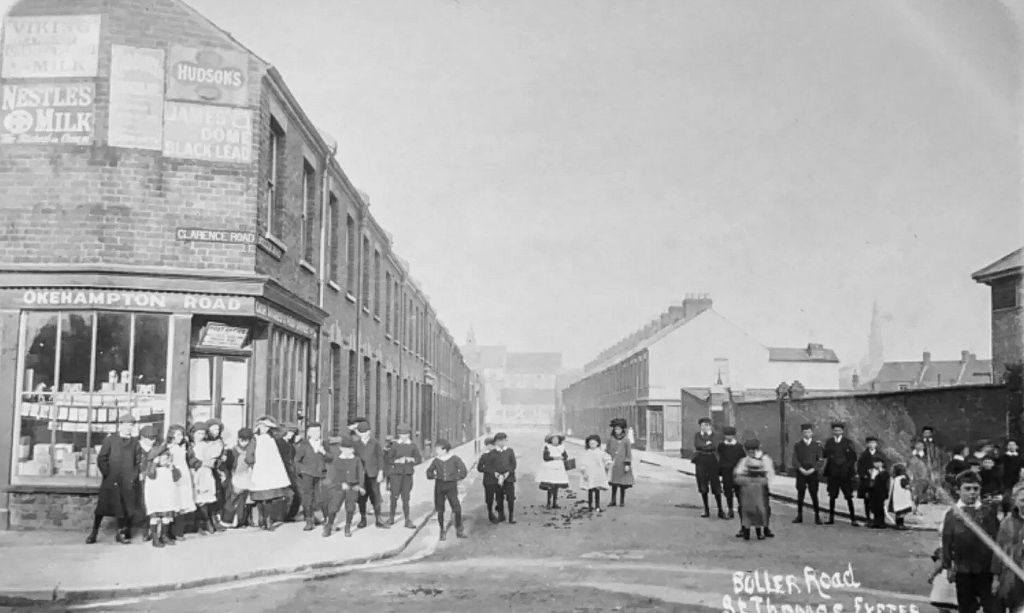
Looking at this photograph of children standing on my road in Edwardian times — smartly dressed, ankle‑deep in the everyday piles of horse manure — I can’t help but smile.
I’m struck not only by the scene itself, but by the world it represents. A camera arriving on a quiet street like this would have been an event, enough to draw every child within earshot. Their faces carry that mixture of curiosity and solemnity that belongs to an age before self‑consciousness, before screens, before the world sped up. All these streets once had corner shops, and even in my childhood they were still part of the landscape — not just places to buy a loaf of bread, but small centres of gravity where neighbours gathered, exchanged gossip, and kept the pulse of the community alive. This was before supermarkets flattened everything into convenience. Even the front room I’m sitting in now was a shop of sorts. There used to be a side door here, long since bricked up by my Father, where the resident would sell small necessities through the window — boxes of matches, a bit of tobacco, perhaps a bar of Pears soap if you were lucky, whatever helped supplement a meagre income. So in a way, I’m part of the continuum of this street’s history, only now tapping away on a modern computer, surrounded not by Swan Vestas matches and penny goods but by shelves of history books and military models, with AI for company.
In moments like this, I feel less like a resident and more like a curator of the street’s memory — and perhaps, in time, I’ll become part of the exhibit myself. Given my years driving taxis, it seems only fitting that I might one day be considered a suitable case for the taxidermist. It would be quite an honour to be stuffed, I suppose. After all, I must be one of the longest‑standing inhabitants of Buller Road, which surely earns me a footnote in the local museum, if not a glass case.
We have come a long way since those children posed for the camera, and thank goodness for it. Yet they lived in a world where the night sky was still visible, where the Milky Way was not a rumour but a companion, and where silence was something you could actually hear. It is a fragment of the Exeter my Father would have recognised — a world swept away within a single lifetime.
I saw that sky again only once in my adult life, in the Carpathian mountains of Ukraine, my mother’s birthplace. The stillness there was almost eerie, as if time itself had paused. The stars were so bright they felt close enough to touch. I lay there looking up, thinking that early humans must have seen exactly the same sight — and that most people alive today never will.
How do you measure progress against something like that? How do you weigh longevity against depth, convenience against silence, motion against stillness?
There is no simple answer. Perhaps the best we can do is notice the trade‑offs, honour what we have gained, and mourn what we have lost — without pretending that one cancels out the other.
And perhaps, in the end, depth is not something the world gives us, but something carved into us. It isn’t common, and it isn’t easy. It comes from struggle, from loss, from the kind of experience that leaves a mark. My Father had it, but only because he had suffered and survived more than most.
His life, in many ways, is the clearest example I know of the transformations I have been trying to describe. He was born into a rural poverty that could almost have belonged to the Middle Ages, in a Poland where everything — politics, economics, even dignity — revolved around land. For the peasant, land was not an asset but a lifeline, the difference between survival and destitution. It is hard for us now, in our world of supermarkets and salaries, to grasp how deep that longing ran.
He remembered, as a small boy, the entire village stopping in its tracks to stare at the sky the first time a plane passed overhead. A single aircraft was enough to bring a community to a standstill. And yet, within the span of his lifetime, he lived to see supersonic flight, satellites, and men walking on the Moon. The world of his childhood — slow, poor, intimate, and innocent in its own way — vanished almost overnight.
Some of that change was the natural momentum of history. But much of it was accelerated, violently and prematurely, by the convulsions of the twentieth century. Old empires collapsed, feudal structures dissolved, and the modern age arrived with a force that left no corner of Europe untouched. As Joachim Fest observed, Hitler — for all his monstrousness — helped propel the world into a new era, sweeping away patterns and hierarchies that might otherwise have lingered for decades. My Father lived right through the middle of that upheaval, carried along by forces far larger than any individual.
He emerged from it with a depth that was not fashionable, not taught, not acquired through comfort or convenience, but forged in hardship and endurance. His life is a reminder that progress is never simply invention and convenience. It is also upheaval, loss, and the disappearance of worlds that once shaped us. And it leaves us with the question that has threaded through all these reflections: what have we gained, and what have we quietly lost, in the rush toward the modern world?